
IT outsourcing can solve a real capacity or capability problem, but only when the engagement is designed around clear ownership. Hiring an external team does not automatically reduce costs, accelerate delivery, or improve quality. Those outcomes depend on what you outsource, how the work is governed, and whether the provider has the right technical and operational fit.
This guide explains how IT outsourcing services work, how the main engagement models differ, what affects cost, and how to evaluate a provider. It also covers the less visible issues that often determine whether an engagement succeeds: product ownership, source-code access, security, documentation, knowledge transfer, and exit planning.
The goal is not to argue that every company should outsource. It is to help you decide which responsibilities can be transferred safely, which should stay in-house, and what evidence to request before signing a contract.
A project-based engagement, dedicated team, and staff augmentation setup solve different problems. Zenkoders can review your scope, technical requirements, timeline, and internal capacity to help identify a suitable delivery model.
What Are IT Outsourcing Services?
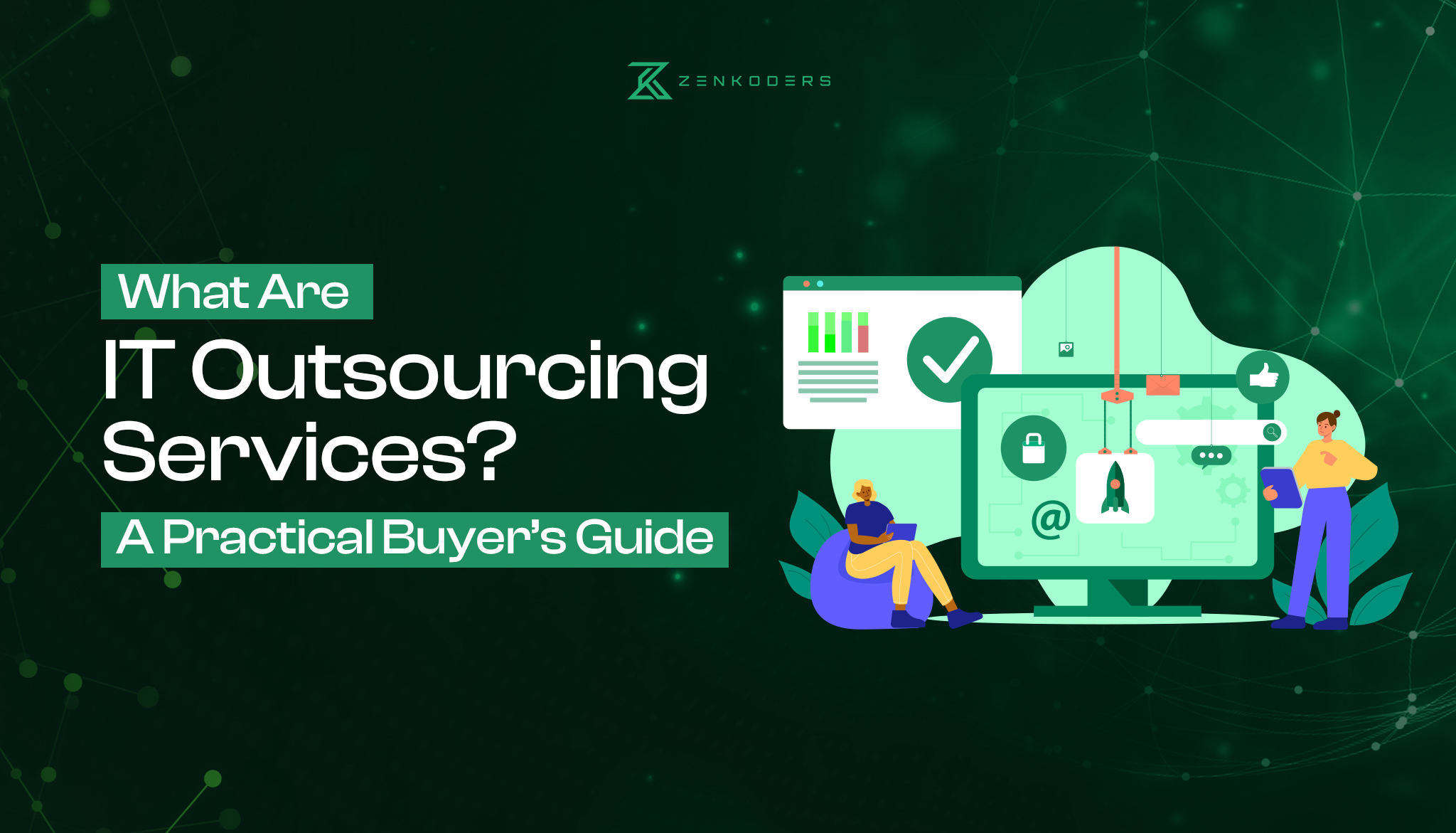
IT outsourcing services involve assigning specific technology work or operational responsibility to an external provider under an agreed scope, delivery model, and governance structure.
A company might outsource a complete software project, add engineers to an internal team, or ask a managed service provider to operate a defined function. Common examples include:
- Custom software and product development
- Web and mobile application development
- Cloud infrastructure and DevOps
- Quality assurance and test automation
- Data engineering and analytics
- Cybersecurity operations
- Help-desk and end-user support
- Application maintenance
- Legacy-system modernization
- AI integration and workflow automation
Outsourcing does not remove the buyer’s accountability for business results, data protection, or product decisions. Even when a provider manages delivery, the client normally needs an internal owner who can set priorities, approve trade-offs, and make timely decisions.
For software initiatives, an external team may handle discovery, design, engineering, testing, deployment, and maintenance. Zenkoders describes these capabilities within its custom software development services, including web, mobile, design, and post-launch support.
What Can a Company Outsource?
A better question than “Can this be outsourced?” is “What knowledge, control, and risk would we transfer by outsourcing it?”
Work that is often suitable for outsourcing
Outsourcing can be practical when the work:
- Requires skills that are difficult to hire locally
- Has a clear business owner and measurable outcome
- Can be separated from highly sensitive internal decisions
- Has enough documentation for an external team to become productive
- Needs temporary capacity rather than a permanent department
- Benefits from specialist experience
- Has a defined handover or continuity plan
Examples include building a mobile application, modernizing a customer portal, adding test automation, implementing a new integration, or providing additional developers for a roadmap.
A company developing a customer-facing platform may outsource custom web application development while retaining product strategy, pricing, customer research, and final release approval internally.
Work that usually requires stronger internal ownership
Be cautious about fully transferring:
- Product vision and commercial strategy
- Final architecture accountability
- Security-risk acceptance
- Regulatory interpretation
- Vendor governance
- Access approval
- Business continuity decisions
- Proprietary algorithms that create core competitive advantage
- Institutional knowledge that cannot be reconstructed easily
An external provider can advise on these areas, but the client should still name an accountable internal decision-maker.
Four Decisions That Define an IT Outsourcing Model
“Offshore,” “staff augmentation,” and “fixed price” describe different dimensions of an engagement. A useful outsourcing plan answers four separate questions:
- What responsibility is being outsourced?
- Where will the provider’s team work?
- Who controls priorities and day-to-day execution?
- How will the provider be paid?
Project outsourcing, staff augmentation, dedicated teams and managed services
|
Model |
Client controls |
Provider controls |
Best suited to |
Main limitation |
|
Project outsourcing |
Business goals, approvals and acceptance |
Delivery of a defined project or workstream |
A bounded product or implementation |
Change can be expensive when scope is rigid |
|
Staff augmentation |
Priorities, workflow and daily management |
Recruiting and employment of specialists |
Filling skill or capacity gaps |
Requires capable internal management |
|
Dedicated team |
Product direction and major priorities |
Stable team composition and delivery support |
Long-term roadmaps with changing requirements |
Cost and scope need active governance |
|
Managed services |
Service expectations and oversight |
Operation of an agreed function |
Support, infrastructure, monitoring or recurring operations |
Less direct control over daily methods |
In staff augmentation, external specialists join the client’s existing workflow. The client generally assigns work and manages delivery. Zenkoders’ IT staff augmentation service is positioned for companies that need to expand an existing technology team. Its related guide explains how IT staff augmentation differs from other engagement models.
A dedicated development team is more stable and may include engineering, quality assurance, design, and delivery roles assigned to one client or product. Zenkoders also publishes a separate guide to building and managing a dedicated development team.
A managed service is outcome- or service-oriented. The provider may be responsible for monitoring, incident handling, maintenance, or another ongoing function against agreed service levels.
Onshore, nearshore and offshore delivery
|
Location model |
Typical characteristic |
Potential advantage |
Potential challenge |
|
Onshore |
Provider is in the same country |
Legal familiarity and working-hour overlap |
Usually higher labor cost |
|
Nearshore |
Provider is in a nearby country or region |
Better time-zone overlap with some cost flexibility |
Cross-border contracting and data issues still apply |
|
Offshore |
Provider is in a more distant country |
Wider talent access and possible cost advantages |
Larger time-zone, communication and governance demands |
|
Hybrid |
Team spans more than one region |
Flexible coverage and skill allocation |
More complex coordination |
Location alone does not determine quality. A mature offshore team with strong documentation and governance may outperform a poorly managed local vendor. Evaluate the actual people, processes, contractual entity, security controls, and communication model.
Fixed price, time and materials, and monthly capacity
Fixed-price contracts work best when deliverables, dependencies, acceptance criteria, and change rules are stable. They provide budget predictability, but providers must price in uncertainty. Late changes usually require a revised statement of work.
Time-and-materials contracts charge for actual effort. They fit discovery work and products whose requirements will evolve. The client receives more flexibility but must monitor priorities, throughput, and budget.
Monthly capacity or dedicated-team pricing reserves a defined team or amount of delivery capacity. It can support continuity and predictable staffing, but the client still needs a prioritized backlog and effective product leadership.
No pricing model removes delivery risk. A fixed price can still fail if the scope is ambiguous, while a time-and-materials engagement can remain controlled when it has clear spending limits, milestones, and review points.
Share your product requirements, existing systems, preferred timeline, and required skills. Zenkoders can help define the likely team structure, delivery approach, and scope before preparing a quote.
Benefits and Limitations of IT Outsourcing
Potential benefits
Access to specialized skills
An external provider can give a company access to technical skills that would take months to recruit internally. This is useful for temporary needs such as cloud migration, mobile development, test automation, or a specialized integration.
Faster team formation
Outsourcing can reduce recruiting lead time when the provider already has suitable people available. It does not eliminate onboarding time. External engineers still need product context, system access, architecture documentation, and clear priorities.
Flexible capacity
A company can add or reduce capacity as roadmap needs change. Contracts should explain notice periods, replacement procedures, minimum commitments, and knowledge-transfer requirements.
Greater focus for internal teams
Outsourcing a defined workstream can allow internal leaders to focus on customers, product strategy, architecture, or operations. This benefit disappears when the engagement requires constant clarification or rework.
Potential cost flexibility
Outsourcing may convert some fixed employment and recruiting costs into project or service expenditure. The actual financial result depends on management overhead, rework, provider margin, security controls, transition costs, and the engagement’s duration.
Important limitations
- Domain knowledge can take time to transfer.
- Poorly documented systems slow onboarding.
- Communication problems can create rework.
- Vendor turnover can disrupt continuity.
- Sensitive access increases third-party risk.
- Weak contracts can create disputes over scope or ownership.
- Excessive dependence on one provider can make exit expensive.
- Internal teams may lose critical knowledge if they disengage completely.
Outsourcing is a management model, not a substitute for management.
When Should You Outsource IT Work?
Outsourcing is often appropriate when you can answer “yes” to most of the following:
- Is there a named internal owner?
- Is the business objective clear?
- Can success be measured?
- Are the required skills understood?
- Can the provider receive the necessary context and access safely?
- Is there a realistic budget for quality assurance, management, and security?
- Can the work be documented and transferred?
- Is there a plan for maintaining the product after launch?
Outsourcing may be the wrong choice when:
- The organization cannot make product decisions promptly.
- The requirements are unclear, but no discovery budget exists.
- The company expects a provider to determine its business strategy.
- The lowest hourly rate is the main selection criterion.
- No one internally can evaluate technical quality.
- Sensitive data cannot be shared under the proposed delivery model.
- The organization is unwilling to document systems or processes.
- The contract does not provide access to code, infrastructure, or project records.
- The work involves core knowledge that the company cannot afford to lose.
In those situations, the first step may be hiring an internal technical leader, completing a discovery phase, or narrowing the initial scope.
How Much Do IT Outsourcing Services Cost?
There is no reliable universal hourly rate for IT outsourcing. A quote depends on the team, service, geography, commercial model, risk, and delivery expectations.
Cost factors
- Role and seniority
- Technical specialization
- Product complexity
- Number of platforms
- Legacy-system constraints
- Design and research requirements
- Testing depth
- Cloud and DevOps responsibilities
- Security and regulatory obligations
- Time-zone overlap
- Delivery-management requirements
- Support hours and response targets
- Contract duration
- Replacement and scaling terms
A lower rate does not necessarily mean a lower project cost. A team that needs more supervision, produces more defects, or lacks relevant experience can cost more over the product lifecycle.
Use a total-cost model
Estimate the cost of outsourcing as:
Provider fees + internal management + tools and infrastructure + security and legal review + transition costs + expected change budget + maintenance and exit costs
For example, a software quote may exclude:
- Cloud hosting
- Third-party APIs
- App-store fees
- Security testing
- Data migration
- Product management
- UX research
- Post-launch monitoring
- Support outside business hours
- Documentation
- Knowledge transfer
Ask every shortlisted provider to state assumptions and exclusions. Comparable proposals require comparable scope.
How to Choose an IT Outsourcing Provider
1. Define the outcome before requesting proposals
Describe the business problem, users, required capabilities, constraints, dependencies, and measures of success.
For a product build, include:
- Target users
- Core workflows
- Required platforms
- Existing systems
- Data sensitivity
- Expected integrations
- Availability and performance needs
- Launch constraints
- Support expectations
A short discovery engagement may be more responsible than requesting a fixed quote from an incomplete feature list.
2. Select the appropriate engagement model
Choose based on control and uncertainty:
- Use staff augmentation when your internal team can direct the work.
- Use project outsourcing for a bounded deliverable.
- Use a dedicated team for a long-term, evolving roadmap.
- Use managed services for an ongoing function with measurable service levels.
3. Evaluate evidence, not sales language
Ask for relevant evidence such as:
- Comparable portfolio work
- Architecture or delivery examples
- Named roles and seniority
- Technical interview access
- Quality-assurance approach
- Code-review process
- Security questionnaire responses
- Reference contacts where available
- Sample status reports
- Sample documentation
- Staff-retention and replacement process
Zenkoders provides a public software-development portfolio that prospective buyers can review as one part of due diligence. A portfolio should start the conversation, not replace technical evaluation or reference checks.
4. Meet the proposed delivery team
Do not evaluate only the sales representative. Interview the technical lead, delivery manager, and key specialists expected to join the engagement.
Discuss a realistic scenario:
- How would the team handle an unclear requirement?
- How are architecture decisions recorded?
- What happens when a release fails?
- Who approves production access?
- How are defects prioritized?
- What happens if a key engineer leaves?
Specific answers reveal more than a generic process presentation.
5. Run a security and compliance review
NIST recommends identifying, assessing, and mitigating cybersecurity risk across the technology supply chain. CISA likewise advises organizations to verify that suppliers maintain an adequate security culture and supply-chain risk-management practices.
At minimum, review:
- Identity and access management
- Multifactor authentication
- Device security
- Source-code access
- Secrets management
- Logging and monitoring
- Secure development practices
- Vulnerability management
- Incident-notification procedures
- Backup and recovery
- Subcontractors and subprocessors
- Data location and transfer
- Staff offboarding
- Business continuity
Relevant sources include NIST SP 800-161 Rev. 1 and CISA’s ICT supply-chain risk-management guidance.
Certifications and independent reports may support due diligence, but they should be checked for scope, date, issuing body, exceptions, and relevance to the proposed service.
6. Start with a controlled first phase
A discovery sprint, prototype, technical assessment, or bounded feature can test:
- Communication
- Estimation
- Code quality
- Documentation
- Responsiveness
- Product understanding
- Security discipline
Define the pilot’s acceptance criteria before work begins. A pilot should produce a useful output, not unpaid speculative work.
7. Check exit readiness before signing
A reliable provider should be able to explain how the engagement would end.
Confirm that:
- The client owns or can retrieve source code.
- Repositories and cloud resources are accessible.
- Credentials can be rotated.
- Documentation is updated.
- Open-source and third-party dependencies are recorded.
- Knowledge-transfer obligations are defined.
- Data-return and deletion procedures are documented.
- Transition support has a price and time limit.
A Practical Provider Scorecard
Score each provider from 1 to 5 using the same evidence standard.
|
Criterion |
Suggested weight |
Evidence to request |
|
Relevant technical capability |
20% |
Team interviews, architecture examples, code-review process |
|
Delivery and governance |
15% |
Reporting sample, escalation path, project plan |
|
Security and privacy |
15% |
Security controls, audit evidence, incident process |
|
Product and domain understanding |
15% |
Discovery questions, relevant work, proposed risks |
|
Team quality and continuity |
10% |
Named team, replacement terms, turnover approach |
|
Communication fit |
10% |
Working-hour overlap, meeting model, written communication |
|
Commercial clarity |
10% |
Assumptions, exclusions, change process, payment terms |
|
Exit and knowledge transfer |
5% |
Handover plan, documentation and data-deletion terms |
Adjust the weights for your risk profile. A healthcare platform may assign more weight to privacy and security; an early prototype may place more weight on product discovery and speed.
Security, Compliance and Intellectual Property
Outsourcing expands the number of people, systems, and organizations that may influence your security posture. Treat the provider as part of your technology supply chain.
Data protection
Identify:
- What data the provider can access
- Why access is necessary
- Where the data is stored
- Which subprocessors are involved
- How access is approved and revoked
- How incidents are reported
- How data is returned or deleted
Apply least-privilege access. Avoid sharing production data in development environments unless there is a documented, approved need and suitable protection.
Regulated data
Legal requirements depend on the data, jurisdiction, role of each party, and service.
For US healthcare work, the Department of Health and Human Services explains that covered entities generally need written contracts with business associates that handle protected health information. Subcontractors that create, receive, maintain, or transmit protected health information on behalf of another business associate may also be covered. Review the HHS guidance on business associate contracts with qualified legal and security professionals.
Do not rely on a provider’s use of phrases such as “HIPAA compliant” or “GDPR certified.” Request evidence and define responsibilities contractually.
Intellectual property
The agreement should address:
- Ownership of custom code and designs
- Pre-existing provider materials
- Third-party and open-source components
- License obligations
- Invention assignment
- Confidential information
- Repository ownership
- Reuse restrictions
- Rights after termination
Obtain legal review for material intellectual-property or regulatory issues.
Contract and Governance Checklist
A practical contract set may include a master services agreement, statement of work, data-processing terms, security requirements, and service-level commitments.
Define:
- Scope and exclusions
- Roles and decision rights
- Deliverables
- Milestones
- Acceptance criteria
- Pricing and invoicing
- Change-control process
- Staffing commitments
- Subcontractor rules
- Security requirements
- Incident notification
- Confidentiality
- Intellectual-property rights
- Warranties and liability
- Service levels
- Documentation standards
- Termination rights
- Data return and deletion
- Knowledge transfer
- Transition assistance
Governance should continue after the contract is signed. Establish a regular operating rhythm:
- Delivery or sprint reviews
- Risk and dependency reviews
- Budget tracking
- Quality metrics
- Security reviews
- Architecture decisions
- Roadmap planning
- Executive escalation when needed
Measure outcomes rather than activity alone. Hours worked and tickets closed may be useful operational measures, but they do not prove user value, reliability, or maintainability.
Common IT Outsourcing Mistakes
Choosing mainly on hourly rate
Rate comparisons ignore productivity, defects, management overhead, and lifecycle cost.
Starting without a product owner
A provider cannot resolve every business trade-off. Delayed decisions create churn and rework.
Treating requirements as permanent
Software requirements change. Contracts need a controlled way to revise scope, priorities, and budget.
Giving broad access too early
Access should follow a documented role and approval process. Remove access promptly when people leave the engagement.
Ignoring documentation until handover
Architecture decisions, runbooks, deployment instructions, and system dependencies should be updated throughout delivery.
Allowing the provider to own every account
Where practical, the client should control critical repositories, cloud accounts, domains, analytics, app-store accounts, and production credentials.
Failing to plan for turnover
Require notification, replacement criteria, overlap, and knowledge transfer for key personnel changes.
Outsourcing accountability
The provider may perform the work, but the client remains responsible for business decisions, risk acceptance, and vendor oversight.
Trends Shaping IT Outsourcing
Several developments are changing how outsourcing relationships are evaluated.
AI-assisted software delivery
Development teams increasingly use AI-assisted tools for coding, testing, documentation, analysis, and support. Buyers should ask how the provider validates generated output, protects confidential information, approves tools, and prevents sensitive code or data from entering unauthorized systems.
AI can improve parts of a workflow, but it does not remove the need for engineering judgment, review, testing, or accountability.
Greater scrutiny of third-party risk
Organizations are examining supplier access, software dependencies, subprocessors, incident response, and business continuity more closely. This makes security evidence and ongoing monitoring more important than broad assurances.
Smaller, specialized partners
Some buyers prefer focused providers for product engineering, data, AI, or cloud work rather than transferring all technology functions to one vendor. Multivendor strategies can reduce concentration risk but increase integration and governance work.
More emphasis on outcomes
Buyers increasingly want agreements tied to service quality, milestones, reliability, or business outcomes. Outcome-based contracts are practical only when the result is measurable and both parties can control the relevant variables.
Is IT Outsourcing Right for Your Organization?
IT outsourcing services are most useful when they solve a specific capability, capacity, or operational problem under clear ownership.
A strong engagement has:
- A defined business outcome
- An accountable internal owner
- An appropriate delivery and pricing model
- Evidence-based provider selection
- Clear security and IP terms
- Regular governance
- Accessible code and documentation
- A realistic exit plan
A weak engagement begins with a vague scope and a low hourly rate, then assumes the provider will solve product strategy, architecture, security, and delivery without active client involvement.
Zenkoders offers custom software development, web application development, mobile app development, and IT staff augmentation. Organizations evaluating an external development team can contact Zenkoders to discuss the product, required skills, constraints, and whether project outsourcing or team augmentation is the better fit.
Before requesting a full proposal, discuss the product, available internal resources, major risks, and delivery constraints with Zenkoders. The goal should be to determine whether outsourcing, staff augmentation, or another approach is the best fit.
FAQs:
What is the difference between IT outsourcing and staff augmentation?
IT outsourcing is the broader practice of assigning technology work to an external provider. Staff augmentation is one outsourcing model in which external specialists join the client’s team and work under the client’s day-to-day direction.
Is IT outsourcing always cheaper than hiring in-house?
No. Outsourcing may reduce recruiting time or fixed employment overhead, but total cost also includes provider margin, internal management, rework, security review, tools, transition, and maintenance. Compare total lifecycle cost rather than hourly rates alone.
Which IT outsourcing model is best for a startup?
A bounded project or dedicated team may suit a startup that lacks an engineering function. Staff augmentation is more appropriate when the startup already has technical leadership and needs additional capacity. The right model depends on product uncertainty, budget, and internal management capability.
How long does it take to onboard an outsourced development team?
Onboarding may take days or several weeks depending on system complexity, access approvals, documentation, data sensitivity, and team size. A structured onboarding plan should cover product context, architecture, environments, workflows, security, and initial deliverables.
How can a company protect its source code when outsourcing?
Use access controls, client-accessible repositories, multifactor authentication, branch protection, code review, contractual IP terms, secure device requirements, logging, prompt offboarding, and regular backups. Legal and security specialists should review high-risk arrangements.
What should an IT outsourcing SLA include?
An SLA should define measurable services, availability or response targets, measurement methods, exclusions, escalation, reporting, remedies, and review procedures. Software-development projects may rely more heavily on acceptance criteria and delivery metrics than uptime-based SLAs.
Can a company switch outsourcing providers later?
Yes, but switching is easier when the client controls critical accounts, maintains current documentation, has clear IP rights, records dependencies, and includes transition assistance in the contract. Without those protections, vendor lock-in can make a change slow and expensive.