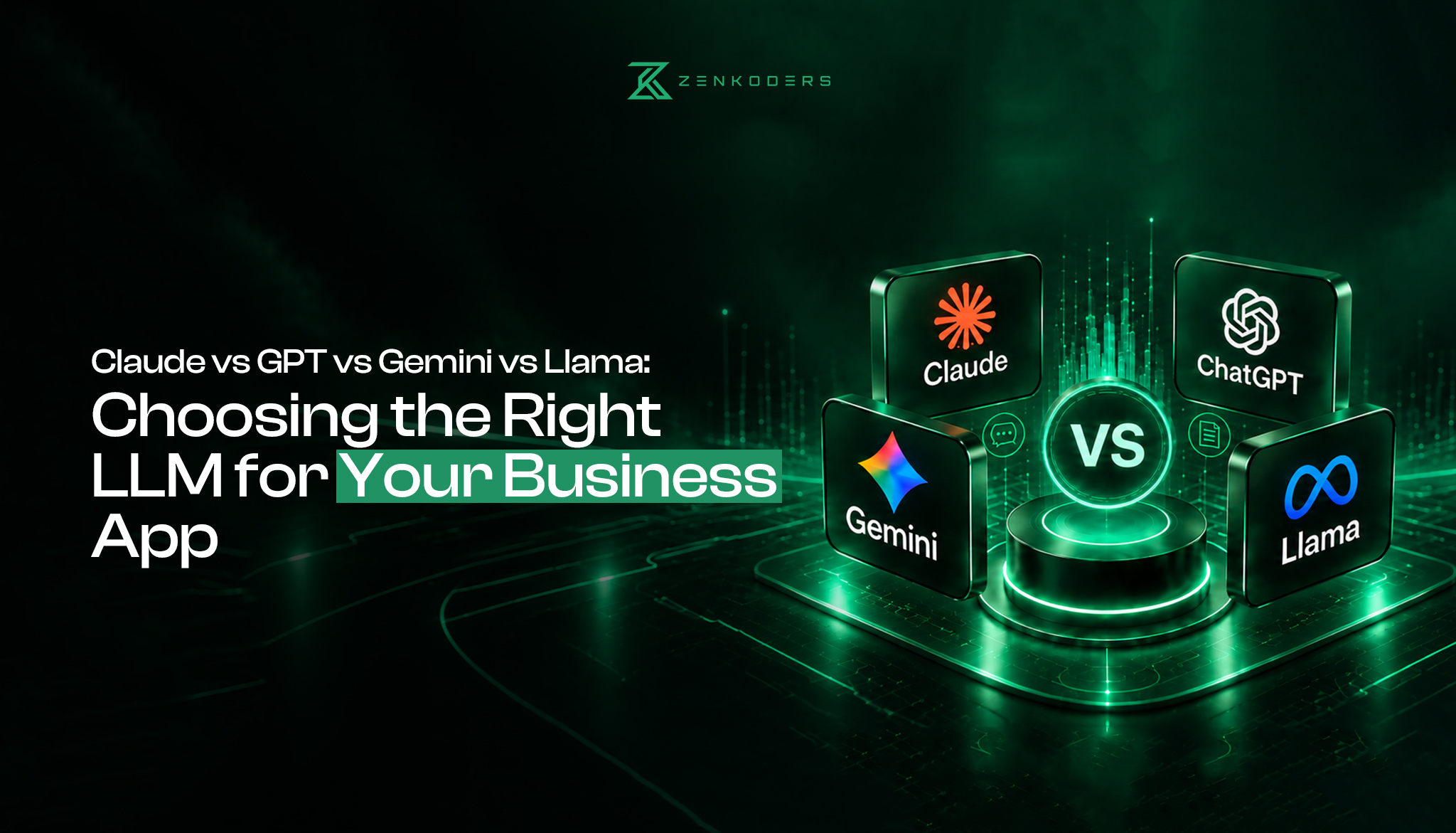

Quick answer: There’s no single best LLM for business apps in 2026. Claude (Sonnet 5 or Opus 5) is a strong default for AI agents, coding and long documents. GPT-5.6 has the widest price range and ecosystem. Gemini is the natural fit for video, audio and Android apps. Open-weight models like Llama and Meta’s Muse Glimmer suit teams that must keep data in-house. Most production apps end up using more than one.
“Which model should we build on?”
We hear that on almost every AI discovery call, usually right after “how much will this cost?” Get it wrong and you can pay five times more than necessary, rewrite prompts six months after launch, or learn that your compliance team won’t approve where the data goes.
Most LLM comparisons also go stale within weeks. In just the last few months, Anthropic released Claude Sonnet 5 and Opus 5, OpenAI split GPT-5.6 into three models and cut prices on two, Google shipped new Flash models while its next Pro model kept slipping, and Meta moved its frontier work from open Llama to a closed model.
So we won’t crown a winner. This guide covers what each model family is good at today, what it really costs to run, and the process we use to pick models for client projects. Prices were checked against vendor pages in September 2026. They’ll change. The framework won’t.
Which LLM Should You Choose? The Short Version
Here’s where we’d start testing for the most common business app needs:
|
If your app needs to… |
Start by testing |
Why |
|
Run AI agents that use tools and finish multi-step tasks |
Claude Sonnet 5 (Opus 5 for harder cases), GPT-5.6 Terra |
Reliable tool use at mid-tier prices |
|
Power a high-volume support chatbot on a tight budget |
GPT-5.6 Luna, Gemini 3.5 Flash-Lite, Claude Haiku 4.5 |
Lowest per-token costs from the major labs |
|
Read long contracts, reports or codebases |
Claude Opus 5, Gemini 3.1 Pro, GPT-5.6 Sol |
Context windows around 1 million tokens |
|
Understand video, audio and images together |
Gemini 3.8 Flash or 3.1 Pro |
Built multimodal from the ground up |
|
Add AI to an Android app or Firebase backend |
Gemini via Firebase AI Logic |
Plugs into Google’s mobile tooling |
|
Keep all data on your own servers |
Muse Glimmer, Llama 4, Mistral, Qwen |
Self-hosted weights, nothing leaves your infrastructure |
|
Handle the hardest reasoning and research work |
Claude Fable 5.1, GPT-5.6 Sol |
Top capability at top-tier prices |
Treat this as a shortlist, not a verdict. The only benchmark that really matters is your own data.
Most don’t. Tell us what you’re building, and we’ll tell you which two or three models are worth testing and which ones to skip.
What’s Actually in Each Model Lineup Right Now?
Claude (Anthropic)
Anthropic sells Claude in four tiers. Haiku 4.5 is the fast, low-cost option for classification and routing. Sonnet 5, released June 30, is the everyday production model. Anthropic scrapped a planned September price rise, so $2/$10 is now its standard rate. Opus 5 is the flagship for complex agents and coding, and Fable 5.1 sits above it for the heaviest reasoning. All except Haiku (200K) handle 1M-token contexts.
In our builds, Claude stands out at following long, detailed instructions, calling tools reliably inside agent workflows, and writing production code. It’s also sold through AWS Bedrock, Google Cloud and Microsoft Foundry, which helps when procurement has already approved one of those clouds. The main gap is that Claude’s API doesn’t generate images, so apps that need image output pair it with another model.
GPT (OpenAI)
GPT-5.6 became generally available in July as three separate models: Sol (flagship), Terra (balanced) and Luna (fastest and cheapest). A late-July price cut took Luna down 80% and Terra down 20%, making Luna one of the cheapest capable models from any major lab. All three offer roughly 1M-token context.
OpenAI’s advantage is breadth: mature SDKs, voice and image tools, Azure availability, and a huge pool of developers who already know the API. The watch-outs are at the top end. Sol has the highest list output price of the flagships here, prompts over 272K tokens cost more, and Sol’s promotional rate is only guaranteed through November 21, 2026. Budget against the list price.
Gemini (Google)
Google’s top model is still Gemini 3.1 Pro, released in February. Gemini 3.5 Pro was announced at Google I/O in May but hadn’t shipped as of early September. Instead, Google has released a run of Flash models, most recently Gemini 3.8 Flash on September 2, with 3.5 Flash-Lite as the budget tier.
Gemini was built multimodal from day one, so it’s the natural pick when your app reasons over video, audio, screenshots and text together. It also fits neatly into Google Cloud, Workspace and Firebase, a real plus for Android and cross-platform apps. Two cautions, though. Google retires models fast (Gemini 2.5 shuts down in October 2026), and some Pro models stay in “preview” for months, which can affect SLA coverage.
Llama and Meta’s Muse Models: What Changed
This is where most comparisons are out of date. Meta’s Llama 4 models (Scout and Maverick, April 2025) are still downloadable and still run in plenty of production systems. But in April 2026, Meta launched Muse Spark, a closed, API-only model, and moved its frontier work there. In August it partly reversed course with Muse Glimmer, a 30-billion-parameter open-weight model under the permissive Apache 2.0 license, built to run AI agents on a single high-end Mac or PC. Meta has also promised open weights for Muse Spark 1.2, with no date.
The wider open-weight market moved on too. By May 2026, Chinese open-weight models such as Alibaba’s Qwen and Moonshot’s Kimi supplied about 61% of tokens on OpenRouter, and Llama had dropped out of its rankings.
So when clients ask about “Llama,” they usually mean: can we run a capable model on our own servers? Yes, but the shortlist is wider than Meta now, and licenses vary. Llama 4 needs a separate Meta agreement above 700 million monthly active users. And Deloitte found 77% of companies weigh an AI vendor’s country of origin, which can rule some open-weight families out early.
How Much Does Each LLM Cost to Run?
Here are standard API prices per million tokens as of September 2026. Input tokens are what you send (prompts, documents, chat history). Output tokens are what the model writes back.
Model | Input / 1M tokens | Output / 1M tokens | Notes |
GPT-5.6 Luna | $0.20 | $1.20 | Cheapest major-lab option |
Gemini 3.5 Flash-Lite | $0.30 | $2.50 | Google’s budget tier |
Muse Glimmer 30B (hosted) | ~$0.30–$0.35 | ~$1.10–$1.50 | Free to self-host; you pay for GPUs instead |
Gemini 3.8 Flash | $0.75 | $3.75 | Google Cloud intro price through Dec 31, 2026 ($1.50/$7.50 after) |
Claude Haiku 4.5 | $1.00 | $5.00 | 200K context |
Claude Sonnet 5 | $2.00 | $10.00 | Now the standard price |
GPT-5.6 Terra | $2.00 | $12.00 | After the July price cut |
Gemini 3.1 Pro | $2.00 | $12.00 | $4/$18 for prompts over 200K tokens |
Claude Opus 5 | $5.00 | $25.00 | Anthropic’s flagship |
GPT-5.6 Sol | $5.00 | $30.00 | Promo $4/$20 through at least Nov 21, 2026 |
Claude Fable 5.1 | $10.00 | $50.00 | Premium reasoning tier |
What That Looks Like in a Real App
Per-token prices are hard to picture, so here’s a realistic example. Imagine a support chatbot handling 100,000 conversations a month, averaging 1,500 input tokens (system prompt, chat history and a few retrieved help articles) and 300 output tokens each. That’s 150 million input and 30 million output tokens a month.
Monthly model bill at list prices, before caching or batch discounts:
Model | Monthly model cost |
GPT-5.6 Luna | $66 |
Gemini 3.5 Flash-Lite | $120 |
Gemini 3.8 Flash (intro price) | $225 |
Claude Haiku 4.5 | $300 |
Claude Sonnet 5 | $600 |
GPT-5.6 Terra / Gemini 3.1 Pro | $660 |
Claude Opus 5 | $1,500 |
GPT-5.6 Sol (list price) | $1,650 |
Claude Fable 5.1 | $3,000 |
Three things stand out when we walk clients through numbers like these.
The spread is huge, but the absolute cost is often small. The priciest option costs 45 times more than the cheapest, yet $3,000 a month is usually less than your maintenance budget. So “just use the cheapest model” can backfire: if a budget model botches 8% of billing questions and each lands on a human agent, the savings vanish.
Tokens aren’t equal across models. Each vendor uses its own tokenizer, and Anthropic says Sonnet 5 produces up to about a third more tokens than Sonnet 4.6 for the same text. Compare cost per completed task, not cost per token.
Caching and agents both change the math. Anthropic and OpenAI charge roughly a tenth of the normal input rate for cached input, which helps when every request repeats a long system prompt. Agents push costs the other way, since one task can mean planning, several tool calls and retries. Our AI agent cost guide shows how those running costs add up after launch.
Claude vs GPT vs Gemini vs Llama: Side-by-Side Comparison
Claude | GPT-5.6 | Gemini | Llama / Muse (open weight) | |
Best known for | Agents, coding, complex instructions | Ecosystem breadth, widest price range | Native multimodal, Google integration | Data control, full customization |
API price range (input / output) | $1–$10 / $5–$50 | $0.20–$5 / $1.20–$30 | $0.30–$2 / $2.50–$12 | Free weights; pay for hosting |
Max context | 1M (200K on Haiku) | ~1M | 1M on 3.1 Pro | Varies (131K hosted Glimmer, up to 10M on Llama 4 Scout) |
Image generation | No | Yes, via separate models | Yes, via separate models | Depends on model |
Where to buy | Anthropic, AWS, Google Cloud, Microsoft Foundry | OpenAI, Azure | Google AI Studio, Google Cloud | Hugging Face, self-hosted, hosting providers |
Biggest watch-out | No image output; top tiers get expensive | Sol output pricing, long-prompt surcharge | Fast deprecations, delayed Pro tier | You own servers, security and updates |
Which LLM Is Best for Your Use Case?
Customer Support Chatbots
Start cheap and route upward. Let Luna, Flash-Lite or Haiku handle password resets and order status, then hand refund disputes or frustrated customers to Sonnet 5 or Terra. That one routing decision can cut model spend by more than half with no visible quality drop. Ourchatbot development andcustom ChatGPT solutions are built around this pattern.
AI Agents and Workflow Automation
For agents, reliability beats price. One fumbled tool call halfway through a ten-step workflow wastes everything spent before it. Our current agent shortlist is Claude Sonnet 5 and Opus 5 plus GPT-5.6 Terra and Sol, tested head to head on the client’s real workflows. Guardrails matter as much as the model. In SailPoint’s research, 80% of organizations said their AI agents had already taken unintended actions. That’s why our AI agent development projects include approval checkpoints and logging, and why complex jobs often usemulti-agent AI systems with narrow permissions.
Document-Heavy Work and Knowledge Assistants
A 1M-token context window is impressive, but stuffing your whole knowledge base into every prompt is slow and expensive. Retrieval-augmented generation (RAG), which fetches only the relevant pages, usually works better and keeps answers grounded in your documents. Long context earns its keep for one-off deep analysis, like reviewing a 400-page contract. Our generative AI development services typically combine both, and our guide onhow to build an AI system explains the architecture.
Mobile Apps
For Android and cross-platform apps, Gemini through Firebase AI Logic is often the fastest route to a shipped feature. For private or offline features, use Apple’s and Google’s on-device models and send only heavy tasks to the cloud. Ourmobile app development team makes this call early, because it shapes the whole backend.
Healthcare, Finance and Other Regulated Industries
Here, the paperwork and the data path matter more than benchmarks. Confirm that the vendor, or the cloud you access it through, will sign a Business Associate Agreement (BAA) for your setup. Check where data is processed and how long it’s retained. Residency can cost extra; OpenAI adds a 10% uplift for regional processing on newer models. For the strictest environments, a self-hosted open-weight model removes the third party entirely. Ourhealthcare app development page covers these requirements in more depth.
Should You Self-Host an Open-Weight Model Instead?
Sometimes. Self-hosting makes sense when data legally can’t leave your environment, when high and steady volume makes API bills painful, when you need deep fine-tuning on proprietary data, or when the model must run offline on edge devices.
It rarely makes sense for low or spiky traffic, teams without ML operations experience, or frontier-level reasoning. “Free” weights still bring GPU costs, monitoring and security patching, which is likely why open-source models run only about 13% of enterprise AI workloads.
Why Smart Teams Don’t Bet on a Single Model
Multi-model setups are now normal. About 37% of enterprises run five or more models in production, and roughly 79% of Anthropic’s enterprise customers also pay for OpenAI.
Price isn’t the only reason. Availability can change quickly, even at the biggest labs. US export controls led Anthropic to suspend access to its Fable 5 and Mythos 5 models for nearly three weeks in June 2026, and OpenAI’s GPT-5.6 Sol first shipped as a limited preview. Add routine deprecations and surprise price changes, and single-vendor lock-in becomes a real business risk.
The fix is cheap if you plan for it on day one. Put a thin gateway layer between your app and the model APIs, version prompts per model, and keep a test set so you can evaluate a new model in an afternoon. It’s standard practice for ourAI development team, and one of the first things missing when we auditvibe coding prototypes that hardwire a single API into every screen.
How We Choose an LLM for a Client Build: 5 Steps
- Define the job, not the model. Write down the task, monthly volume, acceptable response time, the cost of a wrong answer, and how sensitive the data is. These facts rule out half the options before testing starts.
- Build a test set from real data. Collect 50 to 100 real examples, like actual support tickets or documents, with what a good answer looks like. Public benchmarks can’t show how a model handles your customers’ messy questions.
- Run the shortlist side by side. Test two or three models from different vendors, at two price tiers each. Measure accuracy, response time and cost per completed task.
- Check the non-technical blockers. Review data retention, BAA support, data residency, cloud marketplace availability, and license limits for open-weight models.
- Design for switching. Build the gateway layer, keep prompts portable, and re-run your test set every quarter. Your best model in September probably won’t be your best model next March.
Mistakes We Keep Seeing
The big one is picking a model because it topped a leaderboard that week. Benchmarks are narrow and rarely look like your use case. Close behind: using the flagship for tasks a model costing a tenth as much handles fine, ignoring deprecation schedules until a migration notice lands, and treating “open source” as “free” until the GPU bill arrives.
Our Honest Take
If you’re starting a new business app and don’t have strict data-residency rules, test a mid-tier model from two vendors. Claude Sonnet 5 and GPT-5.6 Terra are sensible defaults for most text and agent workloads, and Gemini 3.8 Flash earns a spot if your app handles video or lives in Google’s ecosystem. Keep an open-weight option in your back pocket for when compliance or volume demands it.
Above all, don’t marry a model. Build so you can switch in a week, test on your own data, and let cost per completed task decide. The vendors will keep leapfrogging each other. Your architecture shouldn’t have to care.
Not sure which model fits your app? Our team can run your real data through a side-by-side test of the top models and give you a clear recommendation with cost projections before you commit to a build. Book a free consultation with Zenkoders.
FAQs:
Which LLM is best for business apps in 2026?
No single LLM is best for every business app. Claude Sonnet 5 and Opus 5 are strong for AI agents and coding, GPT-5.6 offers the widest price range, and Gemini leads on video and audio. Test two or three models on your own data before choosing.
Is Claude better than ChatGPT for business use?
Each is better at different things. Claude is widely used for agent workflows, coding and long documents, while OpenAI’s GPT-5.6 has a broader ecosystem, image and voice tools, and a cheaper entry tier in Luna. Many companies use both. Roughly 79% of Anthropic’s enterprise customers also pay for OpenAI.
What is the cheapest LLM for a production app?
Among the major labs, GPT-5.6 Luna is the cheapest at $0.20 per million input tokens and $1.20 per million output tokens, followed by Gemini 3.5 Flash-Lite at $0.30 and $2.50. But the cheapest model isn’t always the lowest total cost. Wrong answers that need human follow-up can quickly outweigh token savings.
Is Llama still a good choice in 2026?
Llama 4 still works well for self-hosted apps, but Meta moved its frontier work to Muse Spark, a closed model, in April 2026. For open-weight projects, also consider Meta’s Apache-licensed Muse Glimmer, Mistral and Qwen. Compare license terms carefully, since Llama 4 requires a separate Meta license above 700 million monthly users.
Which LLM is best for HIPAA-compliant healthcare apps?
Compliance depends more on contracts and architecture than on the model. Confirm the vendor, or the cloud platform you use, will sign a Business Associate Agreement for your setup, and check where data is processed and stored. For maximum control, a self-hosted open-weight model keeps patient data in-house.
How long does it take to integrate an LLM into an existing app?
A focused AI feature or chatbot integration typically takes four to eight weeks, including testing. Complex AI agents connected to several business systems can take three to six months. Data quality and integrations drive the timeline far more than the LLM you choose.