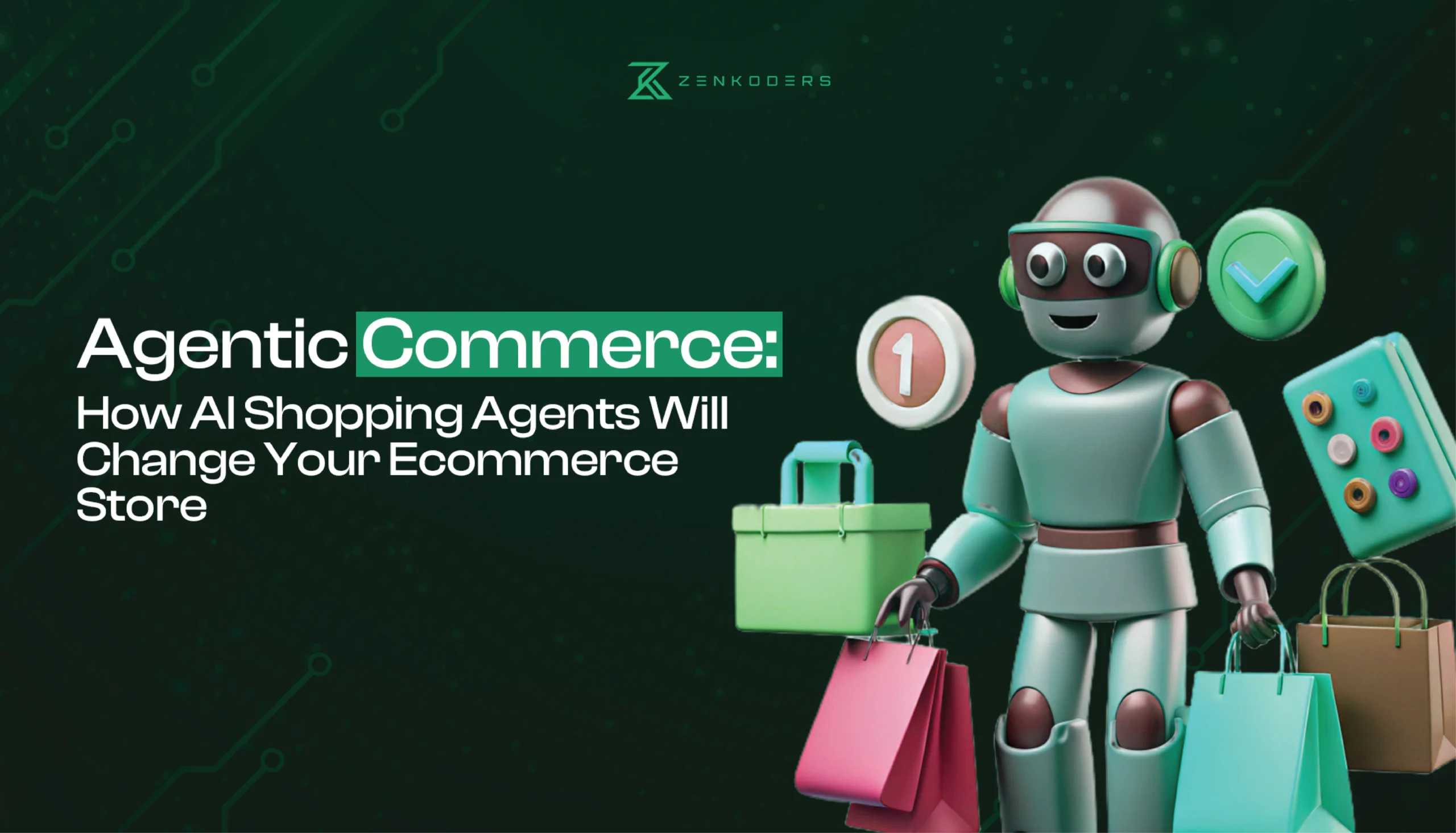

Quick answer: Agentic commerce is when AI agents shop on a customer’s behalf: finding products, comparing prices and policies, and sometimes completing checkout. It’s already live in 2026 through Google, Shopify, Microsoft and the card networks, and AI-referred shoppers now convert better than other traffic. The stores that win will be the ones AI agents can read, trust and buy from.
It’s 9:40 on a Tuesday night. A customer tells her phone, “Find me waterproof trail running shoes under $150, wide fit, that can arrive before Saturday.” Within seconds, an AI agent checks dozens of stores, compares prices, delivery times and return windows, and puts the best match in a cart. She taps once to pay.
She never saw your homepage, your hero banner or your 10%-off popup. If you won that sale, it’s because an agent could read your product data and trusted what it found. If you lost, you probably don’t even know it happened.
That’s agentic commerce, and it’s moving faster than most store owners realize. It’s also noisy. OpenAI launched in-chat checkout, then pulled it six months later. Amazon took an AI shopping agent to court and lost on appeal. Google, Visa and Mastercard all shipped their own standards. This guide separates what’s real from what’s hype, explains how AI shopping agents change the way your store gets found and paid, and gives you a practical 90-day plan to get ready.
What Is Agentic Commerce?
Agentic commerce is shopping where an AI agent does some or all of the work for the buyer. Instead of searching, opening ten tabs and filling out a checkout form, the shopper describes what they want. The agent handles discovery, comparison and sometimes the purchase, within limits the shopper sets.
That’s different from the AI features most stores already run. A recommendation widget suggests products on your site, and a support chatbot answers questions about your store. We’ve covered both in our guides to AI in ecommerce and AI chatbots in ecommerce. An AI shopping agent works for the shopper, not for you, and it may compare you against every competitor before your page ever loads. For the technical background, see our complete guide to agentic AI.
Shopping step | Traditional ecommerce | Agentic commerce |
Discovery | Shopper searches Google or your site | Shopper describes a need to an AI assistant |
Comparison | Shopper opens tabs and reads reviews | Agent compares price, specs, shipping and returns |
Checkout | Shopper fills out your checkout form | Agent hands off to your checkout or pays through a trusted rail |
What wins the sale | Design, ads, copy, SEO | Structured product data, clear policies, reviews, stock |
Most stores aren’t built for it yet. Tell us what you sell and how your catalog is set up, and we’ll show you where an AI agent would get stuck.
Is Agentic Commerce Actually Happening Yet?
Yes, though mostly at the research stage so far. The numbers from the last few months are hard to ignore:
- AI traffic converts better now. Adobe reports that AI-referred traffic to US retail sites grew 62% year over year in July 2026, converted 60% more often than non-AI traffic, and brought in 53% more revenue per visit.
- Shopify merchants are seeing it. In Q1 2026, AI-driven traffic to Shopify stores grew eight times year over year, and orders from AI-powered searches rose nearly 13 times.
- The forecast is big. McKinsey estimates AI agents could orchestrate up to $1 trillion in US retail revenue by 2030, and $3 trillion to $5 trillion globally.
There’s an honest caveat, though. McKinsey’s own 2026 research notes that AI-led discovery and comparison are scaling quickly, while fully autonomous buying is still limited. Most shoppers let the agent research and shortlist, then confirm the purchase themselves. That’s exactly why the time to prepare is now. The agent is already deciding which stores make the shortlist.
Who’s Building the Rails for AI Shopping?
As of September 2026, the major players are taking very different approaches:
Company | What they’re doing | What it means for your store |
Universal Commerce Protocol (UCP) powers buying in AI Mode, Gemini and YouTube, plus a Universal Cart across retailers | The most active live checkout rail; onboarding runs through Merchant Center | |
OpenAI | Retired in-chat Instant Checkout in March 2026; ChatGPT now focuses on discovery and sends buyers to merchant checkout | Your product feed and website matter more than an in-chat buy button |
Shopify | Agentic Storefronts list merchant products in ChatGPT, Microsoft Copilot, Google AI Mode and Gemini | Much of the plumbing is handled if you’re on Shopify |
Amazon | Blocks dozens of outside AI agents and invests in its own assistant, Rufus | A walled garden; other retailers can compete for the agent traffic Amazon turns away |
Visa & Mastercard | Tokenized credentials that let verified agents pay within limits the shopper sets | Agent purchases can run on familiar card rails and fraud controls |
A few details are worth knowing. Google launched UCP in January 2026 alongside Shopify, Etsy, Wayfair, Target and Walmart, and the retailer stays the merchant of record on every UCP purchase. OpenAI said its first version of Instant Checkout wasn’t flexible enough, so merchants now use their own checkout while ChatGPT concentrates on recommendations. And Amazon’s closed approach is clearly working for Amazon: Rufus drove nearly $12 billion in incremental annualized sales in 2025.
ACP vs UCP vs AP2 vs MCP: What Do the Protocols Mean?
These acronyms show up in every agentic commerce conversation. Here’s what each one does:
Protocol | Created by | What it does |
UCP (Universal Commerce Protocol) | Google, with Shopify and major retailers | Lets agents discover products, build carts, check out and manage orders |
ACP (Agentic Commerce Protocol) | OpenAI and Stripe | Originally powered checkout in ChatGPT; now mainly connects merchant product data to ChatGPT |
AP2 (Agent Payments Protocol) | Google, with payment partners | Proves a shopper actually authorized an agent’s purchase |
MCP (Model Context Protocol) | Anthropic, now widely adopted | Lets AI agents connect to tools and data, like your inventory or order system |
You don’t have to bet on a winner. UCP supports integration through standard APIs, Google’s Agent2Agent protocol and MCP, and Visa now offers merchants one integration that accepts agent payments across several protocols. The practical lesson: clean, structured product data works everywhere.
How AI Shopping Agents Will Change Your Ecommerce Store
1. Your Product Data Becomes Your Storefront
Agents don’t care about your hero image. They read attributes like size, material, compatibility, stock, price and delivery time. If those details are missing, locked inside images, or different between your site and your feed, the agent guesses or skips you. Adobe warns that when AI systems can’t read details like pricing or availability, retailers leave revenue on the table.
2. Keywords Give Way to Constraints
Shoppers used to type “trail running shoes.” Now they tell an agent “wide fit, waterproof, under $150, arrives by Saturday.” Each constraint is a filter, and products win by matching on data, not keyword density. Your product pages need to answer the exact questions buyers ask.
3. Your Policies Become Ranking Factors
Agents check what humans used to skim. Industry analysts expect agents to take over price comparisons, credibility checks, return policy scanning and review validation. A vague return policy or a surprise shipping fee is no longer just a conversion problem. It can knock you off the shortlist before a person ever sees you.
4. Checkout May Happen Off Your Site
With Google’s Universal Cart, a shopper can buy from several retailers through Google Pay without visiting any of their websites. You still get the order, but you lose the browsing session, the retargeting pixel and the abandoned-cart email. Plan for it with post-purchase email opt-ins, packaging inserts and loyalty sign-ups, so an agent-driven first order becomes a direct relationship.
5. Your Analytics Will Undercount AI
When research happens inside ChatGPT or Gemini, the first thing you see may be an order, not a visit. Most analytics setups still lump AI referrals into “direct” or “referral.” You’ll need AI-specific channel groups, server-side conversion tracking and order source labels to see what’s really working.
6. You’ll Have to Decide Which Agents to Welcome
Not every agent at your door is a buyer. Amazon sued to stop Perplexity’s Comet shopping agent and won an injunction in March 2026. On August 4, 2026, the Ninth Circuit vacated it, holding that the user, not the AI tool, accesses the website under federal anti-hacking law. The case continues in the lower court and terms of service still apply, but the signal is clear: using the courts to block browser-based agents is uncertain. For most stores, the smarter move is to make shopping easy for legitimate agents and use bot management against harmful traffic. (This isn’t legal advice, so check with counsel for your situation.)
A 90-Day Agent-Readiness Plan for Your Store
Days 1–30: Fix the foundation
- Audit your product data. Fill missing attributes, pull specs out of images, and make sure your site, feed and inventory agree on price and stock.
- Add complete structured data. Use Product, Offer, shipping and return policy schema so AI systems can read what matters.
- Check AI crawler access. Review robots.txt and bot settings so you aren’t blocking the assistants your customers use.
- Track AI traffic. Create an AI referral channel in GA4 and turn on server-side conversion tracking.
Days 31–60: Get listed where agents shop
- Turn on agent channels. Shopify merchants can enable Agentic Storefronts in the admin. Other stores should clean up their Google Merchant Center feed and apply for UCP checkout.
- Make policies machine-readable. Show shipping costs, delivery times and return windows as plain text on product pages.
- Capture customers after the sale. Add opt-ins and loyalty flows so off-site orders still build relationships.
Days 61–90: Test and extend
- Run a prompt test. Ask ChatGPT, Gemini, Copilot and Perplexity 20 questions your buyers really ask, and record whether your products appear and how they’re described.
- Open your systems to agents safely. Expose inventory, order status and returns through a secure API or MCP server with rate limits and logging. Our AI development team often starts client projects right here.
- Update fraud rules. Make sure your risk tools recognize tokenized agent payments instead of flagging them as bots.
If your checkout needs a CAPTCHA, a pop-up, or three clicks too many, the answer is no. We build agent-compatible checkout flows that still convert humans.
Shopify vs Custom Stores: How Your Platform Changes the Work
On Shopify, most of the protocol work is done for you. Agentic Storefronts syndicate your catalog to AI channels, and orders land in your admin labeled with the AI channel that drove them. Your job is mainly data quality, clear policies and measurement.
WooCommerce, Magento, headless and fully custom stores have more work, but also more control. You’ll connect your catalog, cart and checkout to protocols like UCP yourself, usually through APIs or an MCP server, and use a payment partner that supports agent payments, such as Stripe or Visa. That’s the integration work our ecommerce app development and custom web app development teams handle, and it’s a good chance to fix years of messy product data along the way.
Should You Build Your Own AI Shopping Agent?
Outside agents will send you shoppers, but you can also put an agent on your own site or app. Think of it as a personal shopper who knows your catalog inside out. It can answer “Will this fit my 2019 Subaru?” or “What goes with the jacket I bought last month?” and then build the cart. Unlike a basic FAQ bot, it takes action: checking stock, applying rewards, starting a return.
It’s worth it when your catalog is large or technical, when customers need guidance before buying, or when you have enough repeat customers to personalize for. For a store with 30 simple products, it’s usually overkill.
Two rules matter most. First, ground every answer in live data, because an agent that invents a price or promises stock you don’t have creates refunds and angry reviews. Second, pick the model for your real workload; our comparison of Claude, GPT, Gemini and Llama walks through that choice, and our AI agent cost guide covers budgets. Our generative AI development services can also enrich thin product descriptions and attributes at scale, which helps with outside agents too.
Want an AI shopping agent trained on your own catalog? We build AI agents that check live inventory, follow your pricing rules and hand off to a human when it matters. Explore AI Agent Development →
The Risks Worth Taking Seriously
Agentic commerce isn’t all upside. Platform fees can show up fast: Shopify merchants were reportedly set to pay OpenAI 4% on Instant Checkout sales before the feature was retired. Depending on one AI platform for discovery is the same trap many brands fell into with marketplaces and social ads. Adoption can also lag the headlines. In March 2026, Shopify’s president said only about a dozen merchants were actually using ChatGPT’s agentic checkout. And the rules are still being written, from disputes over agent mistakes to how courts treat agents that visit sites uninvited.
None of that is a reason to wait. It’s a reason to invest in what pays off no matter which platform wins: clean data, clear policies, flexible integrations and a direct line to your customers.
Our Honest Take
Agentic commerce won’t replace your website next year. What it’s already doing is moving the moment of decision out of your store and into AI assistants. The winners won’t necessarily be the biggest brands. They’ll be the stores whose products an agent can understand in one pass, whose prices and policies are clear, and whose systems say yes when a legitimate agent is ready to buy.
Start with your product data. It’s the least exciting part of this whole shift, and it decides almost everything else.
Get your store ready for AI shoppers before your competitors do. Book a free 30-minute call with our ecommerce and AI team. We’ll show you how your products appear in AI assistants today and what to fix first. Book a Free Strategy Call → · Prefer email? Send us your store details
FAQs:
What is agentic commerce?
Agentic commerce is online shopping where AI agents act for the buyer. They find products, compare prices, shipping and return policies, and sometimes complete checkout using secure payment tokens. The shopper sets the goal and limits, and the agent does the legwork. Google, Shopify, Visa and Mastercard all support live agentic shopping in 2026.
How do AI shopping agents decide which products to recommend?
AI shopping agents rely mainly on structured, machine-readable information: product attributes, prices, stock, shipping times, return policies and reviews. They match that data against the shopper’s specific constraints. Products with complete, consistent data across your website and product feeds are far easier for agents to recommend than products with thin or conflicting details.
Do I need to change my ecommerce store for AI agents?
Most stores need better data rather than a rebuild. Start by completing product attributes, adding structured data, making policies easy to read, and tracking AI referral traffic. Shopify stores can enable Agentic Storefronts, while custom stores usually need API or protocol integrations to support agent-driven checkout.
What is the difference between ACP and UCP?
UCP, the Universal Commerce Protocol, was built by Google with Shopify and major retailers, and covers discovery, carts, checkout and orders in AI Mode and Gemini. ACP, the Agentic Commerce Protocol, was built by OpenAI and Stripe. It first powered checkout inside ChatGPT, but since March 2026 it mainly connects merchant product data to ChatGPT.
Will AI shopping agents replace ecommerce websites?
Not in the near term. Most agent-driven shoppers still land on or check out through merchant sites, and retailers remain the merchant of record on Google UCP purchases. But more research and comparison will happen inside AI assistants, so your website increasingly has to serve machines reading your data as well as people browsing.
Can I block AI shopping agents from my store?
You can limit automated access with robots.txt, bot management tools and terms of service. However, an August 2026 Ninth Circuit ruling in Amazon v. Perplexity suggests federal anti-hacking law may not stop browser-based agents acting for real users. Most retailers are better off welcoming legitimate agents and blocking only harmful bots.