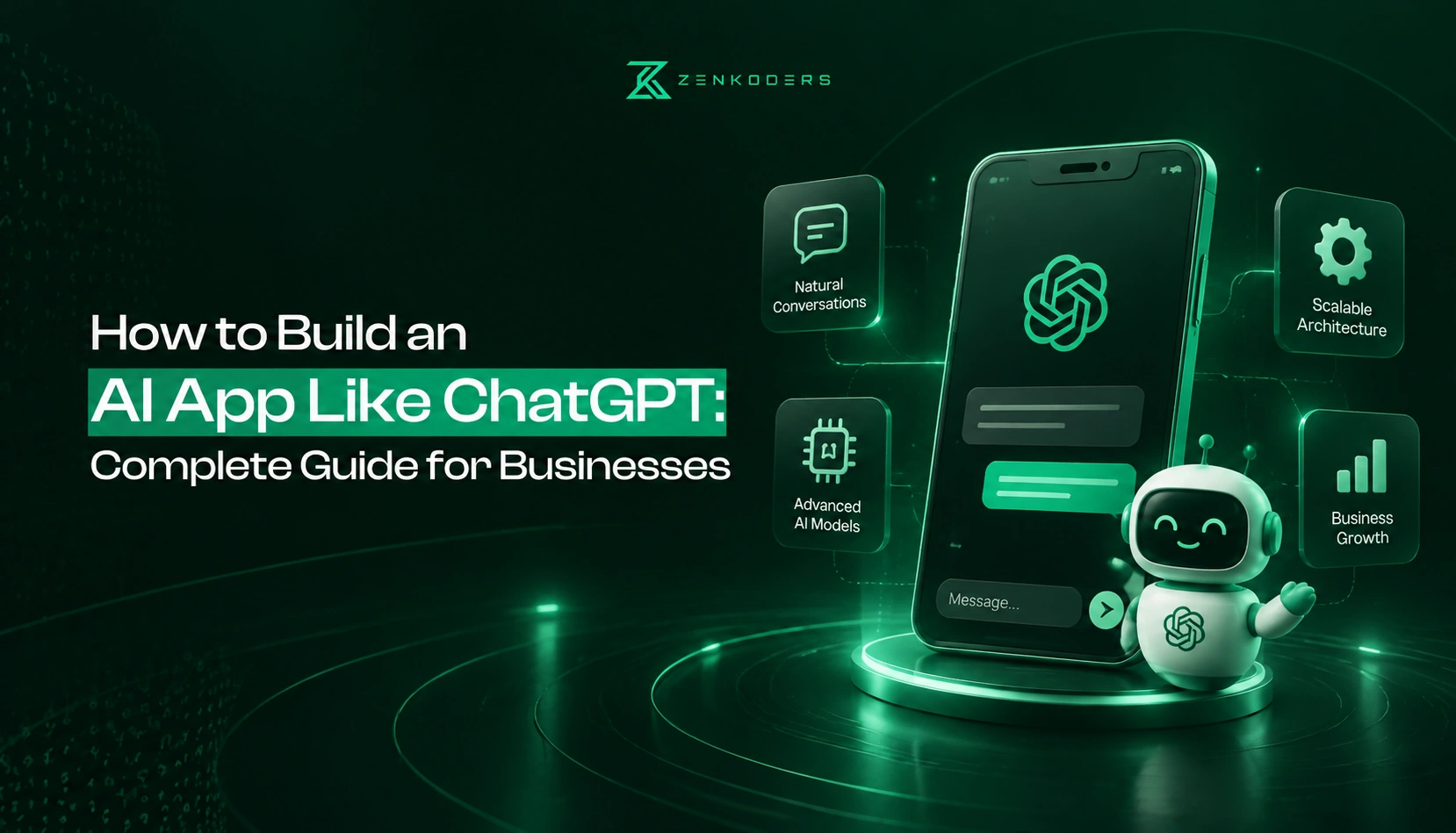

Quick answer: Building an AI app like ChatGPT means connecting a large language model (LLM) such as OpenAI’s new GPT-6 Astra, GPT-5.6, Claude Sonnet 5, or Gemini to your own interface, data, and business logic. For most businesses, that takes 4 to 16 weeks and costs between $15,000 and $150,000+, depending on whether you’re building a focused assistant or a full-scale conversational product. You don’t need to train your own model. You need a clear use case, a solid architecture, and a plan for the parts people underestimate: data quality, guardrails, and ongoing costs.
Below is the process we use at Zenkoders when a client says, “We want something like ChatGPT, but for our business.” It covers what to build, what it costs, which stack to choose, and where projects usually go wrong.
What “An App Like ChatGPT” Actually Means
Let’s clear up the biggest misconception first. When founders say they want to build ChatGPT, they almost never mean building a foundation model. OpenAI, Anthropic, and Google spend billions training those. That is not the game you’re playing, and that’s a good thing.
What you’re building is an application layer on top of an existing model. That layer is where the value lives: your data, your workflows, your users, your brand.
In practice, “an app like ChatGPT” falls into one of three tiers:
Tier | What it is | Typical use case | Complexity |
1. Branded assistant | A chat interface calling an LLM API with a custom system prompt | Internal FAQ bot, simple support assistant, content helper | Low |
2. Knowledge-grounded app | LLM plus your own data via RAG (retrieval-augmented generation) | Customer support on your docs, legal or HR assistants, product advisors | Medium |
3. Agentic product | LLM that takes actions: calls APIs, updates records, runs multi-step tasks | Booking agents, ecommerce shopping assistants, operations copilots | High |
Most of the businesses we work with need Tier 2. A surprising number think they need Tier 3 and discover, after a discovery call, that Tier 2 solves 90% of the problem at a third of the cost. Start by identifying which tier you actually need. Everything downstream depends on it. If you want a second opinion on which tier fits, our AI development services team runs that scoping exercise on every discovery call.
Step-by-Step: How to Build an AI App Like ChatGPT
Step 1: Define one job the app must do well
ChatGPT is general-purpose. Your app should not be. General-purpose assistants for a specific business tend to disappoint because users don’t know what to ask, and the model doesn’t know what to prioritize.
Write a single sentence: “This app helps [user] do [task] using [our data/systems].”
Examples we’ve built around:
- “This app helps clinic patients book, reschedule, and prep for appointments using our scheduling system.”
- “This app helps our sales team answer technical product questions using our internal documentation.”
- “This app helps shoppers find the right product using our catalog and past order history.”
If you can’t write that sentence, you’re not ready to build. You’re ready to research.
Step 2: Choose your LLM (and plan to switch it)
This is the decision people agonize over most, and it matters less than you think, because the models leapfrog each other every few months. What matters more is building so you can switch.
Here’s how the major options compare for business apps as of September 2026:
Model family | Strengths | Watch out for | Best for |
OpenAI GPT-6 Astra (Sept 2026) | Current frontier flagship; strongest on computer use, browsing, long multi-step agent tasks, and producing finished documents; ~1M token context; notably more resistant to prompt injection than GPT-5.6 | Premium pricing ($10 / $50 per million input/output tokens); off by default in Enterprise workspaces; restricted on some cybersecurity tasks | Tier 3 agentic products, complex reasoning, apps that operate inside other software |
OpenAI GPT-5.6 Sol / Luna | Cheaper, fast, strong tool use, wide ecosystem support | GPT-5.5 retires from ChatGPT and Codex on October 14, 2026, so model migration is a real ongoing task | Tier 1 and 2 apps, high-volume everyday queries, the “cheap lane” in a routing setup |
Anthropic Claude (Fable 5.1 / Opus 5 / Sonnet 5) | Long context, careful instruction following, strong coding and agent performance; Fable 5.1 (Sept 1, 2026) is the current frontier tier | Fewer consumer-facing plugins than OpenAI | Document-heavy apps, agents, regulated industries |
Google Gemini | Native multimodal, tight Google Workspace integration | Best value is inside Google’s ecosystem | Apps on Google Cloud, image/video-heavy use cases |
Open-source (Llama, Mistral, Qwen) | Full control, no per-token vendor cost, self-hostable | You own infrastructure, scaling, and security | Strict data residency, very high volume, on-prem |
Step 4: Design the architecture
Here’s the reference architecture we use for a Tier 2 or Tier 3 app. It’s deliberately boring. Boring scales.
Frontend
- Web: React or Next.js with streaming responses (users expect to see tokens appear as they’re generated; a 6-second blank wait feels broken)
- Mobile: React Native or Flutter if you need iOS and Android from one codebase
Backend / orchestration
- Node.js (NestJS) or Python (FastAPI)
- An orchestration layer that handles prompt assembly, retrieval, tool calls, and conversation memory
- Frameworks: LangChain or LlamaIndex can speed up the start; many teams outgrow them and write a leaner custom layer. Either path is fine.
Data layer
- Vector database: pgvector (inside PostgreSQL) for most projects; Pinecone or Weaviate if you’re past tens of millions of vectors
- Relational DB for users, conversations, and analytics: PostgreSQL
- Object storage for source documents: S3 or equivalent
LLM layer
- Primary model via API (in 2026, typically GPT-5.6 or Claude Sonnet 5 for everyday queries)
- Escalation model for complex or multi-step tasks (GPT-6 Astra or Claude Opus 5 / Fable 5.1), selected by a router based on query type; this routing logic is standard in our AI agent development builds
- Fallback model from a different vendor for outages
- Caching layer for repeated queries: this alone can cut API costs by 20 to 40% in support use cases
Safety and observability
- Input/output guardrails (PII detection, prompt-injection filtering, topic restrictions)
- Logging every prompt, retrieval, and response with trace IDs
- Evaluation pipeline that runs your test prompts on every deploy
Infrastructure
- AWS, Azure, or GCP; containerized; autoscaling behind a queue for burst traffic
The two pieces teams skip are the last two. Guardrails and evaluations feel like polish. They are not. They are the difference between an app you can put in front of customers and an app you have to babysit.
Step 5: Build the conversation, not just the chat box
A chat box is easy. A good conversation is design work, and it’s where most of the effort in our chatbot development and UI/UX design projects actually goes.
Things we’ve learned matter far more than expected:
- Suggested prompts on the empty state. Users freeze at a blank input. Give them three starting points tied to real tasks.
- Streaming with a stop button. Non-negotiable.
- Visible sources. When the app answers from your documents, show which ones. This builds trust and drastically reduces “is this made up?” support tickets.
- Graceful “I don’t know.” Train (via prompt) the app to say when your data doesn’t cover a question, and route to a human. An assistant that confidently guesses is worse than no assistant.
- Memory boundaries. Decide explicitly what the app remembers across sessions and tell users. ChatGPT’s own memory system now updates automatically; your users will expect similar continuity, and they’ll also expect to control it.
The answer depends on your prompts, not the benchmarks. Share your use case and we’ll tell you which two models are worth testing and which ones will just cost you more.
Step 6: Add guardrails before anyone outside the team touches it
Real risks we’ve seen in production:
- A support bot offering a refund policy that didn’t exist because a user asked leadingly
- Prompt injection hidden inside a user-uploaded PDF instructing the model to ignore its rules
- Personal data from one user’s conversation surfacing in retrieval for another
Minimum guardrail set:
- System prompt with explicit scope and refusal rules
- Retrieval scoped per user/tenant (never a shared index without access filters)
- PII redaction on inputs and logs
- Output validation for anything that triggers an action (Tier 3)
- Rate limiting and abuse detection
- A human escalation path that actually reaches a human
Step 7: Evaluate like an engineer, not like a demo
Demos lie. The app looks brilliant on the ten questions the founder asks and falls apart on the hundred customers ask.
Build a test set of 100 to 300 real questions (pull them from support tickets, sales calls, search logs). Score responses on accuracy, groundedness, tone, and safety. Automate this with an LLM-as-judge plus human spot checks. Run it on every prompt change and every model update.
This is the single practice that separates AI apps that ship from AI apps that stay “almost ready” for six months.
Step 8: Launch small, measure, expand
Launch to one segment: one team, one customer cohort, one product category. Instrument everything: resolution rate, escalation rate, thumbs up/down, cost per conversation, latency.
Then expand the scope one job at a time. Every AI product that’s succeeded for our clients started narrow and earned its way to broad.
How Much Does It Cost to Build an AI App Like ChatGPT?
Costs split into two buckets that businesses routinely conflate: build cost (one-time) and run cost (ongoing, and it scales with usage).
Build cost by tier
Tier | Scope | Timeline | Estimated cost (agency, 2026) |
Tier 1: Branded assistant | Chat UI, system prompt, auth, basic logging | 3 to 6 weeks | $15,000 to $40,000 |
Tier 2: Knowledge-grounded app | Above + RAG pipeline, document ingestion, sources, guardrails, evals | 8 to 14 weeks | $40,000 to $120,000 |
Tier 3: Agentic product | Above + tool integrations, multi-step workflows, action validation, mobile app | 14 to 24+ weeks | $100,000 to $300,000+ |
These are ranges from projects we’ve scoped and delivered, not industry averages. Rates vary with team location (US-based agencies run higher; hybrid teams with US leadership and global engineering, like ours, land in the middle) and with how clean your source data is. Messy data is the most common reason a Tier 2 budget grows. For a more detailed breakdown, see our custom ChatGPT development services page or our guide on the cost to hire a mobile app developer in 2026.
Run cost (monthly)
Cost item | Low usage (~10K conversations/mo) | High usage (~500K conversations/mo) |
LLM API tokens | $200 to $800 | $10,000 to $60,000 |
Vector DB + hosting | $50 to $300 | $1,500 to $8,000 |
Cloud infrastructure | $100 to $500 | $3,000 to $15,000 |
Monitoring / eval tools | $0 to $200 | $500 to $3,000 |
Maintenance (prompt updates, model migrations, data refresh) | $1,000 to $3,000 | $5,000 to $20,000 |
Two cost levers that matter most: model routing (send easy queries to a cheap fast model and hard ones to a premium model like GPT-6 Astra; this typically saves 40 to 60% on tokens) and caching. Build both in from the start.
Build, Buy, or Wrap? An Honest Comparison
Not every business should build. Here’s how we frame the decision on discovery calls.
Option | What it means | Pros | Cons | Choose it when |
Use ChatGPT/Claude directly | Give your team consumer or business plans | Zero build cost, fast | No integration with your systems, limited control, no customer-facing product | Internal productivity only |
No-code / SaaS bot builder | Intercom Fin, Zendesk AI, Chatbase, etc. | Days to launch, low cost | Locked to vendor’s data model and pricing; hard to differentiate | Standard support use case, small team |
Custom build | Your own app on top of an LLM API | Full control, your data, your UX, becomes an asset | Higher upfront cost, needs ongoing ownership | The AI experience is core to your product or differentiation |
Self-hosted open model | Run Llama/Mistral on your own infra | Data never leaves your environment; no per-token vendor fees | You own scaling, updates, and security; needs ML ops skill | Strict compliance, very high volume |
A pattern we see often: a company starts with a SaaS bot builder, hits its ceiling within a year (usually on integrations or per-resolution pricing), then commissions a custom build. That’s not a failure; it’s a reasonable path. Just know that most of the SaaS setup work doesn’t transfer.
What GPT-6 Astra Changes for Businesses Building AI Apps
OpenAI released GPT-6 Astra on September 3, 2026, and it’s worth addressing directly because it changes some decisions in this guide, and leaves others exactly where they were.
What actually changed
- Tier 3 got more realistic. The biggest gains in Astra are in long-horizon agentic tasks: using a computer, browsing signed-in sites, completing multi-step workflows, and producing finished deliverables like formatted slide decks and documents. Agentic products that were fragile a year ago are now buildable with acceptable reliability.
- Prompt injection got harder. OpenAI’s system card reports Astra is significantly more robust to prompt injections than GPT-5.6 Sol. That is welcome, but it is not a reason to remove your own guardrails. Treat it as a second layer, not the first.
- Context got enormous. A roughly 1M token context window means whole codebases, contract sets, or product catalogs can fit in a single request. This doesn’t make RAG obsolete (stuffing a million tokens per query is expensive and slow), but it does make hybrid approaches, where you retrieve broadly and let the model reason over more, practical.
- Enterprise access is opt-in. Astra is off by default in Enterprise workspaces and must be enabled by an administrator. If you’re building for enterprise clients, expect procurement and security review to be part of the timeline.
What didn’t change
- You still don’t train your own model.
- You still need your own data pipeline, evaluation set, and guardrails.
- The app-layer cost estimates in this guide hold. Only the token line item moves, and only if you route everything to Astra, which you shouldn’t.
- Model deprecation is still a fact of life. Astra will be superseded too. The abstraction layer remains the most important architectural decision you’ll make.
Our practical recommendation
Build your evaluation set first, run it against GPT-5.6, Claude Sonnet 5, and GPT-6 Astra, and look at where Astra’s extra cost actually buys better outcomes. In our early testing, the answer is: multi-step agent tasks and complex document generation, yes; straightforward Q&A over your docs, rarely. Route accordingly.
Common Mistakes When Building AI Apps (And How to Avoid Them)
- Starting with the model instead of the problem. Teams spend weeks comparing benchmarks and zero hours interviewing users. Flip that ratio.
- Skipping RAG hygiene. Dumping 4,000 PDFs into a vector store without cleaning, deduplicating, or chunking sensibly produces confidently wrong answers. Data prep is usually 30 to 40% of a Tier 2 project.
- No evaluation set. If you can’t measure quality, you can’t improve it, and you can’t tell when a model update quietly degraded your app.
- Ignoring deprecation cycles. Model versions retire. Build the abstraction layer, keep your evals, and treat model migration as a scheduled quarterly task, not an emergency.
- Underestimating the “last 20%.” Getting to a demo takes 20% of the effort. Handling edge cases, adversarial users, latency spikes, and cost overruns is the other 80%.
- Treating it as a one-time project. An AI app is closer to a garden than a building. It needs tending: prompts drift, data goes stale, user behavior changes.
Trends Shaping AI Apps in 2026
If you’re building now, design for where the market is heading, not where it was.
- Agents over chat. The industry is moving from “answer my question” to “do this for me.” ChatGPT’s own roadmap reflects this: scheduled tasks, webhook triggers, browser actions on signed-in sites, and a Data agent that connects to Databricks and Snowflake. Even if you launch a Tier 2 app, architect so Tier 3 actions can be added without a rebuild.
- Agentic commerce. OpenAI is testing Sponsored Agents in ChatGPT and has integrated ChatGPT Ads with HubSpot and Shopify. Shoppers will increasingly buy through AI intermediaries. Ecommerce apps need machine-readable catalogs and agent-compatible checkout, which is now a standard part of our ecommerce app development scope.
- Frontier capability is arriving faster than budgets adjust. GPT-6 Astra (September 2026) and Claude Fable 5.1 landed within days of each other, and free ChatGPT users now get unlimited text chats on GPT-5.6 Luna. When near-frontier capability is either free or a routing decision away, your app’s moat is not the model. It’s your data, integrations, and workflow fit.
- Voice and multimodal by default. Native voice APIs and image understanding have matured. Users increasingly expect to talk to and show things to your app, on web and in mobile apps alike.
- Regulation and trust. The EU AI Act obligations phase in through 2026 and 2027; US states are moving on their own rules. Transparency (labeling AI, showing sources, logging decisions) is shifting from nice-to-have to required.
You don’t need to out-build OpenAI. You need an assistant that knows your data and works inside your systems. Tell us what you’re building and we’ll show you how we’d approach it.
FAQs:
Can I build an AI app like ChatGPT without training my own model?
Yes, and you should. Nearly all business AI apps use an existing model via API (OpenAI, Anthropic, Google) or a self-hosted open model. Training a foundation model costs hundreds of millions of dollars and offers no advantage for a business application.
How long does it take to build an AI app like ChatGPT?
A branded assistant: 3 to 6 weeks. A knowledge-grounded app with RAG: 8 to 14 weeks. An agentic product with integrations: 14 to 24+ weeks. Timelines stretch most often because of messy source data, not engineering.
What's the difference between a chatbot and an AI app like ChatGPT?
Traditional chatbots follow scripted decision trees. LLM-based apps understand natural language, reason over context, and can draw on your documents or take actions. The gap in capability is enormous, and so is the gap in how you need to test and govern them.
Do I need RAG or fine-tuning?
RAG for facts and anything that changes (policies, products, docs). Fine-tuning only for tone and format, and only after RAG is working. Most businesses never need fine-tuning.
Which is better for a business app: GPT, Claude, or Gemini?
It depends on your prompts. Run 50 real queries through two candidates and score them with your own team. Broadly: GPT for ecosystem breadth and (with Astra) agentic work, Claude for long documents and agents, Gemini for Google-native and multimodal work. Build so you can switch.
Should I build my AI app on GPT-6 Astra?
Use it where it earns its cost: complex multi-step agents, computer or browser use, and finished document generation. For everyday Q&A and support, a cheaper model like GPT-5.6 or Claude Sonnet 5 performs nearly as well at a fraction of the price. Most well-built apps use a router that sends only the hard requests to Astra.
How much more does GPT-6 Astra cost than GPT-5.6?
Astra is priced at $10 per million input tokens and $50 per million output tokens, several times the cost of GPT-5.6. Requests over 272K input tokens are billed at higher rates, and batch or flex processing runs at half the standard price. For most business apps, the practical cost impact depends entirely on how much traffic you route to it.
How do I keep the AI from making things up?
Ground it in your data with RAG, show sources, instruct it to say “I don’t know” when retrieval finds nothing relevant, and run an evaluation set that specifically tests for hallucinations. You won’t get to zero, but you can get to reliably low.
Is my data safe when using OpenAI or Anthropic APIs?
Business API tiers from major vendors do not train on your data by default and offer enterprise agreements, data residency options, and compliance certifications. GPT-6 Astra, for example, supports Zero Data Retention for eligible API customers. Review the current data-usage terms of whichever vendor you pick, and add your own PII redaction layer regardless.
How much does it cost to run an AI app monthly?
From a few hundred dollars for low-volume internal tools to tens of thousands for high-traffic consumer apps. Token usage is the biggest variable; model routing and caching are the biggest savings.
Can a small business afford to build an AI app?
Yes, if the scope is right. A focused Tier 1 or lean Tier 2 app in the $15K to $50K range is realistic, and the run costs at small scale are modest. The mistake is trying to build “ChatGPT for everything” on a small budget.
Should I build on ChatGPT (Custom GPTs) or build my own app?
Custom GPTs are a fast way to prototype and reach existing ChatGPT users, but you don’t control the UX, the data pipeline, or the business model. If the AI experience is part of your product, build your own app and keep a Custom GPT as a distribution channel, not the product.