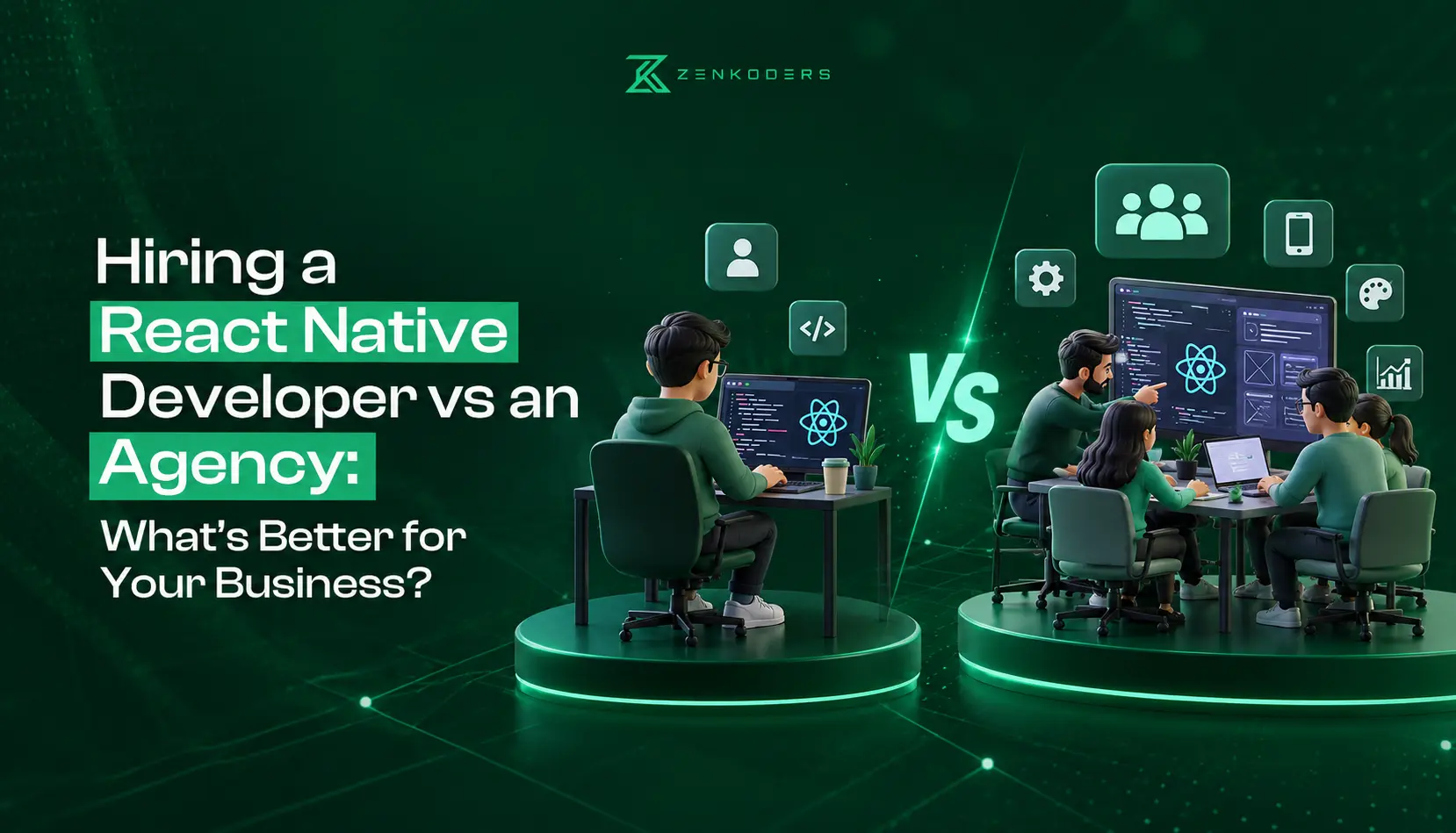

Quick Answer: Hire a React Native developer (freelance or in-house) if you have a small, well-defined project, a limited budget, and the technical knowledge to manage the work yourself. Hire a React Native agency if you need a complete product, meaning design, development, testing, deployment, and ongoing support, with less management effort and lower delivery risk. Startups building a simple MVP often start with a freelancer, while businesses building complex or long-term apps usually get better results from an agency.
Key Takeaways
- A freelance React Native developer is the lowest-cost option and works best for small, clearly defined tasks when you can manage the work yourself.
- An in-house React Native developer offers full dedication and deep product knowledge, but comes with the highest total cost and the slowest hiring process.
- A React Native agency provides a complete team (design, development, QA, DevOps, and project management), which lowers delivery risk and speeds up complex projects.
- Compare the total cost of ownership, not just hourly rates. Rework, management time, and missing skills often make the cheapest option the most expensive one.
- Many growing businesses choose a hybrid model, such as staff augmentation or a dedicated team, to combine agency reliability with in-house control.
Introduction
React Native, the open-source framework created by Meta, has become one of the most popular ways to build cross-platform mobile apps. It lets businesses build iOS and Android apps from a single JavaScript or TypeScript codebase, which cuts development time and cost compared to building two separate native apps.
Once you decide to invest in React Native app development, the next question is who will build your app. You have three main options:
- A freelance React Native developer, hired per project or per hour
- An in-house React Native developer, hired as a full-time employee
- A React Native development agency, a company with a complete team
Each option affects your budget, timeline, app quality, and long-term success in different ways. This guide compares them across every factor that matters, so you can make the right decision for your business.
Skip the research and talk directly to our React Native team about your idea.
What Does a React Native Developer Do?
A React Native developer is a mobile engineer who builds iOS and Android apps from a single codebase using React Native, JavaScript or TypeScript, and the wider React ecosystem. Their typical responsibilities include:
- Building user interfaces with React components and hooks
- Managing app navigation with libraries like React Navigation or Expo Router
- Handling state management with tools like Redux Toolkit, Zustand, or React Query
- Integrating REST or GraphQL APIs and backend services such as Firebase, Supabase, or Node.js
- Writing native modules in Swift or Kotlin when a feature needs direct device access
- Testing with Jest, React Native Testing Library, and Detox
- Building and releasing apps through Expo Application Services (EAS), Xcode, and Android Studio
A single developer can be highly skilled, but they usually specialize in development. Design, QA, project management, and DevOps often fall outside their core role.
What Is a React Native Development Agency?
A React Native development agency is a company that provides end-to-end mobile app development services. Instead of one person, you get a coordinated team, which usually includes:
- Project manager, who handles timelines, communication, and delivery
- UI/UX designer, who creates wireframes, prototypes, and the visual design through dedicated UI/UX design services
- React Native developers, often a mix of senior and mid-level engineers
- Backend developer, who builds APIs, databases, and server logic
- QA engineer, who handles manual and automated testing
- DevOps specialist, who sets up CI/CD pipelines, app store deployment, and monitoring
Agencies follow a defined process, usually agile with two-week sprints, and take responsibility for delivering a complete, working product.
What Are the Pros and Cons of Hiring a Freelance React Native Developer?
Freelancers are independent professionals you hire through platforms like Upwork, Toptal, and Fiverr, through LinkedIn, or through referrals.
Pros of Hiring a Freelancer
- Lower cost: Freelancers have no office overhead, so their rates are usually lower than agency rates.
- Flexibility: You can hire for a single feature, a bug fix, or a short project without a long-term commitment.
- Direct communication: You speak directly with the person writing your code, with no middle layers.
- Fast start: A good freelancer can often begin within days.
- Global talent pool: You can hire from anywhere, including cost-effective regions like South Asia and Eastern Europe.
Cons of Hiring a Freelancer
- Limited skill set: One person rarely covers design, backend, QA, and DevOps equally well.
- Single point of failure: If the freelancer gets sick, busy, or disappears, your project stops.
- Management burden: You have to plan tasks, review code, and track progress yourself.
- Inconsistent quality: Skill levels vary widely, and proper vetting requires time and technical knowledge.
- Uncertain long-term support: Freelancers may move on to other clients after your project ends.
- Security and IP risks: Without proper contracts, code ownership and data protection can become unclear.
What Are the Pros and Cons of Hiring an In-House React Native Developer?
An in-house developer is a full-time employee who works only on your product.
Pros of an In-House Developer
- Full dedication: Your product is their only focus.
- Deep product knowledge: They learn your business, users, and codebase over time.
- Direct control: You manage priorities yourself and can change direction quickly.
- Team collaboration: They work closely with your marketing, sales, and product teams.
Cons of an In-House Developer
- Highest total cost: Salary plus benefits, equipment, software licenses, training, and office costs add up quickly.
- Slow hiring: Recruiting, interviewing, and onboarding can take weeks or months.
- Retention risk: Skilled React Native developers are in high demand and may leave for better offers.
- Remaining skill gaps: One in-house developer still cannot cover design, QA, and DevOps alone.
What Are the Pros and Cons of Hiring a React Native Agency?
A React Native agency is the most complete option. You pay more per hour, but you get a full team, a proven process, and contractual accountability.
Pros of Hiring an Agency
- Complete team: Design, development, testing, and deployment are handled under one roof.
- Proven process: Agencies follow structured workflows with discovery, sprints, reviews, and QA.
- Faster delivery: Multiple specialists work in parallel, which shortens timelines.
- Lower risk: If one developer leaves, the agency replaces them without stopping your project.
- Accountability: Contracts, service level agreements (SLAs), and reputation give agencies strong reasons to deliver.
- Scalability: You can add or reduce team members as the project grows.
- Post-launch support: Most agencies offer maintenance, bug fixes, and React Native version upgrades.
- Cross-project experience: Agencies have solved similar problems for other clients, which helps them avoid common mistakes.
Cons of Hiring an Agency
- Higher hourly rates: You pay for the team, process, and overhead.
- Less direct contact: Communication usually goes through a project manager.
- Less flexibility for tiny tasks: Some agencies have minimum project sizes.
- Varying quality: Not all agencies are equal, so you still need to research carefully.
- Shared attention: Agencies work with multiple clients at the same time.
Get a full React Native team with design, development, QA, and a dedicated project manager, all working on your timeline.
React Native Developer vs Agency: Side-by-Side Comparison
The table below compares all three hiring options across the factors that matter most to business owners.
Factor | Freelance Developer | In-House Developer | React Native Agency |
Upfront cost | Low | High (recruitment and salary) | Medium to high |
Ongoing cost | Lowest hourly rate | Fixed salary plus benefits | Higher hourly rate |
Team size | 1 person | 1 person | Full team |
Skill coverage | Development only | Development only | Design, development, QA, DevOps |
Time to start | Days | Weeks to months | 1 to 2 weeks |
Delivery speed | Slower for large apps | Moderate | Fastest for complex apps |
Project management | You manage it | You manage it | Agency manages it |
Quality assurance | Limited | Limited | Dedicated QA process |
Risk level | High | Medium | Low |
Scalability | Low | Low | High |
Long-term support | Uncertain | Strong | Strong (via contract) |
Best for | Small tasks, simple MVPs | Ongoing product work | Complete, complex apps |
How Much Does Each Option Cost?
Cost is often the deciding factor, but the hourly rate alone can mislead you. Rates vary widely by region, experience level, and project complexity. The ranges below are general market estimates, not fixed prices.
Hiring Option | Typical Rate Range | Hidden Costs to Consider |
Freelancer (South Asia or Eastern Europe) | About $20 to $60 per hour | Your management time, rework, separate designer and QA |
Freelancer (US or Western Europe) | About $60 to $150 per hour | Same as above |
In-house developer | Annual salary plus roughly 20 to 40% for benefits and overhead | Recruitment, onboarding, equipment, turnover |
Offshore agency | About $25 to $60 per hour | Time zone coordination |
US or Western Europe agency | About $100 to $200+ per hour | Minimum project sizes |
Why the Cheapest Option Is Not Always the Cheapest
The total cost of ownership matters more than the hourly rate. A freelancer charging $30 per hour may take longer, need a separate designer, and produce code that needs fixing later. An agency charging $45 per hour may finish faster with fewer bugs, which lowers the final cost. Before you decide, compare the full project estimate, including design, testing, deployment, and at least six months of maintenance.
Should You Hire a React Native Developer or an Agency?
The right choice depends on four things: the size of your project, your budget, your technical knowledge, and how long you plan to keep developing the app.
When to Hire a React Native Developer
Hiring an individual developer is usually the right choice when:
- Your project is small and well-defined, such as a simple app with a few screens
- You need a specific task done, like a bug fix, a new feature, or a library upgrade
- You have technical knowledge, or a CTO who can review code and manage the work
- Your budget is tight, and you want to validate an idea before investing more
- You already have a team, and only need to fill one React Native skill gap
- You are building a long-term product and want an in-house developer who grows with it
If you want vetted talent without a long recruitment cycle, you can hire React Native developers through an established agency and still keep direct control over the work.
When to Hire a React Native Agency
An agency is usually the better choice when:
- You need a complete product, from idea and design to launch
- You do not have a technical background and need expert guidance
- Your app is complex, with features like payments, real-time chat, maps, or live order tracking, which are common in ecommerce and food delivery apps
- Speed matters, and you need to launch before your competitors
- You need reliability, with contracts, deadlines, and accountability
- You need ongoing maintenance, including iOS and Android OS updates, React Native upgrades, and app store compliance
- You are in a regulated industry, such as fintech or healthcare, where security and compliance matter
Hire pre-vetted React Native developers who can start within days and work as part of your team.
Decision Framework: Which Option Fits Your Situation?
Your Situation | Recommended Option |
Non-technical founder building a first app | Agency |
Startup testing a simple MVP on a small budget | Freelancer |
Funded startup building a scalable product | Agency first, in-house team later |
Company with an existing tech team | Freelancer or in-house developer |
Enterprise building a complex or regulated app | Agency |
Need a quick fix or one new feature | Freelancer |
Product that needs daily development for years | In-house developer or dedicated agency team |
The Hybrid Option: Dedicated Teams and Staff Augmentation
You do not always have to choose one or the other. Many businesses use a hybrid model:
- Staff augmentation: ThroughIT staff augmentation, an agency provides React Native developers who join your existing team and follow your processes.
- Dedicated development team: Youhire dedicated React Native developers who work only on your product, similar to in-house staff but without the hiring burden.
- Agency-to-in-house transition: An agency builds and launches the app, then trains your in-house team to take over.
This approach combines the reliability of an agency with the control of in-house development, and it works especially well for growing startups.
How to Evaluate a React Native Developer or Agency
How to Evaluate a React Native Developer
If you choose a freelancer or an in-house developer, check these skills:
- Strong JavaScript and TypeScript fundamentals
- Deep knowledge of React, including hooks, context, and component lifecycle
- Experience with both Expo and the React Native CLI
- Familiarity with the React Native New Architecture (Fabric, TurboModules, JSI) and the Hermes engine
- State management experience with Redux Toolkit, Zustand, or React Query
- Native module knowledge for iOS (Swift) and Android (Kotlin)
- Testing experience with Jest and Detox
- Experience publishing apps to the Apple App Store and Google Play Store
Before hiring, review live apps they have published, check their GitHub or code samples, and give a small, paid test task.
How to Evaluate a React Native Agency
- Portfolio: Do they have published React Native apps in your industry? A good agency will openly share itsportfolio of live projects.
- Reviews: Check verified reviews on Clutch, GoodFirms, Trustpilot, and Google.
- Process: Can they clearly explain their discovery, design, development, and QA process?
- Team: Will you know who is working on your project?
- Communication: Which tools do they use (Slack, Jira, ClickUp), and how often do they report progress?
- IP ownership: Does the contract state that you own 100% of the source code?
- Security: Will they sign an NDA and follow secure coding practices?
- Support: What post-launch maintenance do they offer, and at what cost?
- Pricing model: Fixed price, time and materials, or dedicated team? Which one fits your project?
Questions to Ask Before You Hire
These questions reveal experience and fit quickly:
- Which React Native apps have you published, and can I download them?
- Do you use Expo or the React Native CLI, and why?
- How do you handle features that need native iOS or Android code?
- How do you test the app before release?
- Who owns the source code, design files, and app store accounts?
- How do you estimate timelines, and what happens if the scope changes?
- What does post-launch support include?
- How will we communicate, and how often will I see progress?
Red Flags to Watch Out When Hiring
- Prices far below market rates combined with unrealistic timelines
- No portfolio of live, published apps
- Refusal to sign an NDA or transfer code ownership
- Vague answers about process, testing, or deployment
- Slow or unclear communication during the sales stage
- No mention of post-launch support
- Requests for full payment upfront without milestones
- Pressure to skip the discovery phase and start coding immediately
How Zenkoders Helps Businesses Build React Native Apps
Zenkoders is a software development company with offices in San Francisco and Delaware that has completed more than 1,000 projects for startups and enterprises. Our React Native team handles the full lifecycle: ideation, UI/UX design, development, QA testing, app store launch, and ongoing support. Clients can work with us on a fixed-scope project, a dedicated team, or staff augmentation, depending on how much control they want. You can read verified client feedback on our Clutch, Upwork, and Fiverr profiles.
Conclusion: Which Is Better for Your Business?
There is no single right answer. The best choice depends on your project size, budget, technical knowledge, and long-term goals.
- Choose a freelance React Native developer for small, well-defined tasks when you can manage the work yourself.
- Choose an in-house developer when you need someone working on your product full-time for years.
- Choose a React Native agency when you need a complete, high-quality app delivered on time with low risk and ongoing support.
For most businesses building their first serious mobile app, an experienced React Native app development company offers the best balance of speed, quality, and reliability. As your product grows, you can move to a hybrid model or build your own in-house team.
FAQs:
Is it cheaper to hire a React Native developer or an agency?
A freelance React Native developer usually has a lower hourly rate than an agency. However, an agency can be more cost-effective overall for complex projects, because it provides design, testing, and project management in one package and often delivers faster with fewer bugs.
Can one React Native developer build a complete app?
Yes, a skilled React Native developer can build a simple or moderately complex app alone. For apps that need professional UI/UX design, a custom backend, thorough testing, and app store deployment, one person may struggle to deliver everything at a high standard.
How long does it take to build a React Native app?
A simple React Native app typically takes around 2 to 3 months, a medium-complexity app around 3 to 6 months, and a complex app 6 months or longer. Agencies can often shorten these timelines because multiple specialists work in parallel.
Should a startup hire an agency or a freelancer?
A startup with a very small budget and a simple MVP can start with a freelancer. A startup with funding, a non-technical founder, or a complex product idea usually benefits more from an agency, because it reduces risk and speeds up the launch.
What skills should a React Native developer have?
A strong React Native developer should know JavaScript and TypeScript, React hooks, navigation, state management, API integration, basic native iOS and Android development, testing, and app store publishing. Experience with the New Architecture and the Hermes engine is a strong plus.
Who owns the source code when I hire an agency?
Ownership depends on your contract. A trustworthy agency or freelancer will transfer full intellectual property rights and source code to you. Always confirm this in writing before the project starts.
What is the difference between a dedicated team and an agency project?
In a fixed agency project, the agency delivers a defined scope for an agreed price. In a dedicated team model, the agency provides developers who work only on your product long-term, and you control the priorities, similar to an in-house team.
Can I switch from a freelancer to an agency in the middle of a project?
Yes. Most agencies can take over an existing React Native codebase. They usually start with a code audit to check quality, security, and architecture, then continue development or fix issues before adding new features.
Is React Native still a good choice for app development in 2026?
Yes. React Native is actively maintained by Meta and a large open-source community. The New Architecture and the Hermes engine have improved performance, and companies continue to use it for production apps on both iOS and Android.
What should I prepare before hiring a React Native developer or agency?
Prepare a clear description of your app idea, target users, core features, reference apps you like, your budget range, and your target launch date. This helps you get accurate estimates and compare options fairly.