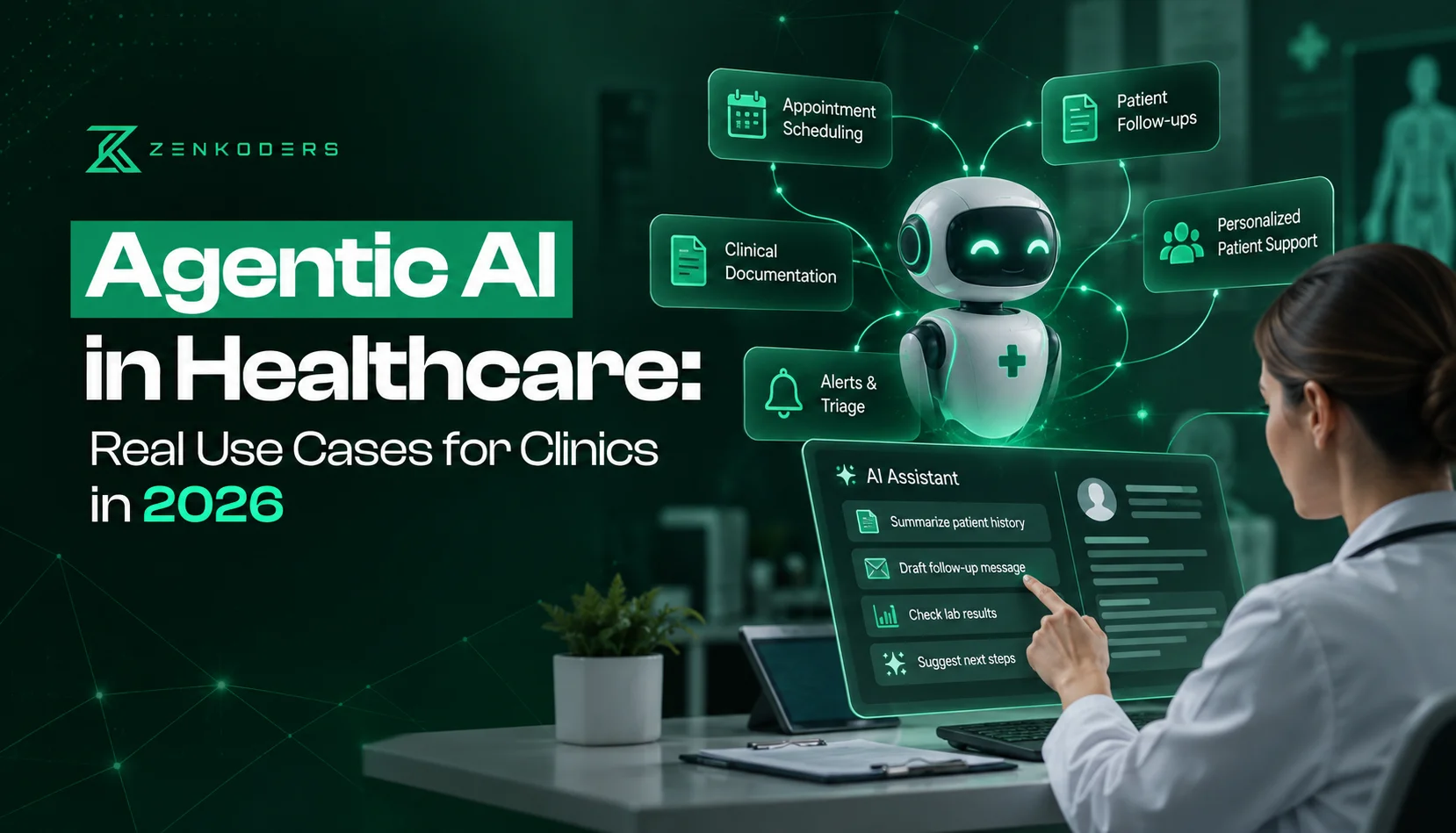

Quick answer: Agentic AI in healthcare refers to AI systems that can plan, decide, and complete multi-step tasks on their own, such as verifying insurance, booking appointments, drafting clinical notes, and following up with patients, while a human stays in control of clinical decisions. In 2026, clinics use AI agents mainly to cut administrative work, not to replace clinicians.
Most clinics do not have a doctor shortage problem first. They have a paperwork problem. Front-desk teams chase prior authorizations, nurses answer the same refill questions all day, and physicians finish charts at night. Agentic AI is the first wave of healthcare technology built to take over entire workflows rather than single clicks.
This guide explains what agentic AI actually is, where clinics are using it today, what it costs, where it goes wrong, and how to adopt it safely under HIPAA. It is written for clinic owners, practice managers, CMIOs, and digital health founders evaluating healthcare app development with AI built in.
Key takeaways
- Agentic AI handles goal-based, multi-step tasks across systems like the EHR, phone, payer portals, and patient messaging.
- The strongest 2026 use cases are administrative: ambient documentation, prior authorization, scheduling, revenue cycle, and patient follow-up.
- Human-in-the-loop design, audit logs, and a signed BAA are non-negotiable for any agent that touches PHI.
- Clinics get the fastest ROI by starting with one narrow, high-volume workflow and expanding after measured results.
What Is Agentic AI in Healthcare?
Agentic AI in healthcare is software that receives a goal, breaks it into steps, uses tools to complete those steps, and checks its own progress until the goal is met. A chatbot answers a question. An AI agent finishes the job.
For example, give a scheduling agent the goal “rebook every patient affected by Dr. Khan’s cancelled Thursday clinic.” It reads the schedule in the EHR, finds open slots, texts each patient, handles replies, updates the calendar, and flags anyone who needs a human call. That is agentic behavior.
Most healthcare AI agents share four building blocks:
- A reasoning model. A large language model (LLM) that plans steps and interprets messy inputs like faxes, voicemails, and free-text notes.
- Tools and integrations. Secure connections to the EHR, practice management system, payer portals, phone system, and patient messaging, usually through FHIR and HL7 APIs.
- Memory and context. Access to the patient record, clinic policies, and past interactions so the agent acts on the right information.
- Guardrails. Rules about what the agent may do alone, what it must escalate, and what it must never touch.
Get a free 30-minute workflow review with our healthcare team.
Agentic AI vs Generative AI vs RPA
These three terms are often mixed up. The difference matters when you budget and plan a project.
Capability | Rule-based automation (RPA) | Generative AI (chatbots, copilots) | Agentic AI |
What it does | Repeats fixed, scripted clicks | Generates text, summaries, answers | Plans and completes multi-step goals |
Handles messy input | No, breaks on changes | Yes, reads unstructured text | Yes, and acts on it |
Takes actions in systems | Yes, but only scripted ones | Rarely, mostly suggests | Yes, across several tools |
Adapts when a step fails | No | No | Yes, retries, reroutes, or escalates |
Human role | Builds and maintains scripts | Reviews every output | Approves key decisions, handles exceptions |
Clinic example | Copying data between two screens | Drafting a patient letter | Running the full prior authorization cycle |
In short, generative AI is the brain, and agentic AI is the brain plus hands. Many clinics already use a healthcare chatbot. An agent is the next step: it does not just talk to patients, it completes the task they asked for.
Why 2026 Is the Tipping Point for AI Agents in Clinics
AI in healthcare has moved from pilots to daily operations, but agents are still early. That gap is the opportunity for clinics that move carefully now.
- AI is now mainstream in US health systems. An Eliciting Insights survey of 120 health systems found 75% use at least one AI application in 2026, up from 59% in 2025. Clinical note-taking leads at 68% adoption. (Fierce Healthcare)
- Agents specifically are still early. Research by Microsoft and The Health Management Academy, published in NEJM in January 2026, found 43% of provider organizations are piloting agentic AI, but only 3% run agents in live workflows. (Microsoft)
- Investment is accelerating. Deloitte reports 85% of healthcare leaders plan to increase agentic AI investment over the next two to three years, and 61% are already building agentic initiatives. (Chief Healthcare Executive)
- Health systems prioritize operations first. More than 80% of health systems surveyed by Deloitte prioritize agentic AI for clinical operations, care delivery, and revenue cycle management. (Deloitte)
- Regulation is pushing automation-ready data. Under the CMS Interoperability and Prior Authorization Final Rule (CMS-0057-F), impacted payers must decide urgent prior authorization requests within 72 hours and standard ones within seven days since January 1, 2026, and must run FHIR-based Prior Authorization APIs by January 1, 2027. (CMS fact sheet)
The last point matters most for clinics. Standardized FHIR APIs give AI agents a clean, compliant way to check requirements, submit requests, and track decisions without screen-scraping payer portals.
There is also a warning sign. NVIDIA’s 2026 industry survey data, as analyzed by several industry reviewers, shows generative AI use far ahead of AI agent use. Action-based tools need deeper integration, wider access rights, and stricter governance than tools that only suggest. Clinics that plan for those three requirements up front avoid the stalled-pilot trap.
8 Real Use Cases of Agentic AI for Clinics in 2026
The use cases below are ordered from most proven to most emerging. Each one replaces a workflow, not just a task.
1. Ambient Clinical Documentation Agents
An ambient AI scribe listens to the visit (with patient consent), drafts the SOAP note, suggests ICD-10 and CPT codes, queues orders for the physician to approve, and writes the after-visit summary in plain language. The physician reviews and signs.
This is the clearest win so far. In a Yale New Haven Health study published in JAMA Network Open, burnout among ambulatory clinicians fell from 51.9% to 38.8% after 30 days with an ambient scribe, and after-hours documentation dropped by nearly one hour per week. (Sidebench summary)
Best for: primary care, behavioral health, specialty clinics with long visit notes.
2. Prior Authorization Agents
A prior authorization agent checks whether a payer requires approval, pulls the supporting clinical notes and lab results from the EHR, fills the request, submits it, tracks the status, and drafts an appeal if the request is denied. Staff step in only for clinical judgment calls and peer-to-peer reviews.
With payers now giving specific denial reasons and moving to FHIR APIs, this workflow is becoming much easier to automate end to end.
Best for: orthopedics, oncology, imaging centers, and any clinic with high prior auth volume.
3. Intelligent Scheduling and Waitlist Agents
Scheduling agents book, confirm, reschedule, and fill cancellations across phone, SMS, web chat, and the patient app. They match visit type to provider and slot length, apply clinic rules, and backfill no-shows from a waitlist automatically.
Best for: multi-provider practices, urgent care, dental, and physical therapy clinics with high no-show rates.
4. Insurance Eligibility and Patient Intake Agents
Before the visit, an intake agent verifies coverage, estimates the patient’s out-of-pocket cost, collects digital forms, reads uploaded insurance cards and ID photos, and updates demographics in the practice management system. The front desk handles exceptions only.
Best for: any clinic losing revenue to eligibility denials or slow check-in.
5. Revenue Cycle and Denial Management Agents
Revenue cycle agents scrub claims before submission, flag coding gaps, predict likely denials, work denied claims, and draft technical or clinical appeals for biller review. This is one of the fastest-growing categories in 2026, with AI-prepopulated appeals growing quickly across health systems.
Best for: clinics with in-house billing teams or high days in accounts receivable.
6. Patient Follow-Up and Chronic Care Agents
After discharge or a new diagnosis, a care agent checks in on symptoms, reminds patients about medications, collects readings from connected devices, and escalates warning signs to a nurse. For remote patient monitoring programs, it also tracks the data needed for billing.
Best for: diabetes, hypertension, cardiology, and post-surgical follow-up programs using wearable integrations.
7. Inbox and Refill Management Agents
Physician inboxes are full of refill requests, lab result questions, and portal messages. An inbox agent sorts messages by urgency, drafts replies for clinician approval, prepares refill requests against protocol, and routes anything clinical to the right person.
Best for: primary care and internal medicine practices with heavy portal message volume.
8. Clinic Operations and Staffing Agents
Operations agents forecast patient volume, adjust staff schedules, manage room allocation, track supply levels, and alert managers about bottlenecks. They connect scheduling data with staffing data, which humans rarely have time to do daily.
Zenkoders built a healthcare staff scheduling app for Tribal Health with geofencing, break management, and timesheet views. Features like these become the tools an operations agent can act on, which is why the underlying app architecture matters before adding agents.
Best for: multi-location clinic groups and urgent care networks.
We’ll help you pick the one AI agent with the fastest ROI for your practice.
Agentic AI Use Cases at a Glance
Use this table to match each use case to your clinic’s biggest bottleneck and the level of human oversight it needs.
Use case | What the agent does on its own | What a human approves | Main benefit | Maturity in 2026 |
Ambient documentation | Drafts notes, codes, summaries | Final note and orders | Less charting time, lower burnout | High |
Prior authorization | Gathers records, submits, tracks, drafts appeals | Clinical justification, peer-to-peer | Faster approvals, fewer delays | Medium, rising with FHIR APIs |
Scheduling and waitlist | Books, reschedules, backfills cancellations | Exceptions and rule changes | Fewer no-shows, fuller schedules | High |
Eligibility and intake | Verifies coverage, collects forms, reads cards | Coverage exceptions | Fewer eligibility denials | High |
Revenue cycle and denials | Scrubs claims, predicts denials, drafts appeals | Appeal submission, coding disputes | Faster cash, lower denial rate | Medium |
Patient follow-up and RPM | Checks in, reminds, collects device data | Any clinical escalation | Better adherence, earlier alerts | Medium |
Inbox and refills | Triages, drafts replies, preps refills | Every clinical reply and prescription | Less inbox overload | Medium |
Operations and staffing | Forecasts volume, adjusts schedules | Staffing decisions | Lower overtime, smoother flow | Emerging |
Pros and Cons of Agentic AI for Clinics
Agentic AI saves real staff time, but it also adds new risks that a simple chatbot does not. Weigh both before you commit budget.
Pros | Cons |
Removes repetitive admin work from front desk, billing, and nursing staff | Needs deep EHR and payer integration, which takes time and budget |
Runs 24/7, so patients get answers and bookings outside office hours | Errors can spread across systems because the agent takes actions, not just suggestions |
Reduces clinician burnout by cutting charting and inbox time | Requires wider data access, which raises HIPAA and security exposure |
Speeds up cash flow through faster prior auth, cleaner claims, and quicker appeals | LLMs can still hallucinate, so clinical outputs need human review |
Scales with patient volume without hiring at the same rate | Staff may resist or over-trust the system without proper training |
Creates detailed audit trails of every action taken | Ongoing costs for model usage, monitoring, and maintenance |
Improves patient experience with faster responses and fewer missed follow-ups | Regulations for autonomous clinical AI are still evolving |
Bottom line: the pros are strongest in administrative workflows. The cons grow quickly as an agent moves closer to clinical decisions, which is why most clinics keep a human in the loop for anything diagnostic or prescriptive.
Compliance, Safety, and Governance: What Clinics Must Get Right
An AI agent that touches patient data is a HIPAA matter from day one. Because agents act across several systems, governance has to be designed in, not added later.
HIPAA and PHI protection
- Sign a Business Associate Agreement (BAA) with every vendor in the chain, including the LLM provider, cloud host, telephony, and messaging services.
- Apply minimum necessary access. Give each agent only the data and permissions its task requires. A scheduling agent does not need full clinical notes.
- Encrypt data in transit and at rest, and keep PHI out of prompts sent to any model that is not covered by a BAA.
- Log everything. Every read, write, message, and decision should be recorded in an immutable audit trail tied to the agent’s identity.
HHS has also proposed updates to the HIPAA Security Rule that would make several of these safeguards, such as encryption and asset inventories, explicit requirements. Check the current status of that rule before you finalize your security plan.
FDA and clinical decision boundaries
If an agent diagnoses, recommends treatment, or drives clinical decisions without meaningful human review, it may fall under FDA oversight as Software as a Medical Device (SaMD). Industry analysis reports that, as of April 2026, the FDA had not cleared any agentic clinical AI system. (Mindbowser analysis) For clinics, the safe zone in 2026 is administrative automation plus clinician-approved clinical drafts.
Interoperability standards
Build agents on HL7 FHIR R4 APIs and SMART on FHIR authorization wherever the EHR supports them. Standard APIs are more secure, easier to audit, and less fragile than screen-scraping or robotic clicking. Our healthcare app development team designs FHIR-ready architecture for exactly this reason.
Guardrails every clinic agent needs
- Human-in-the-loop checkpoints for any clinical, financial, or patient-facing decision above a defined risk level.
- Clear escalation rules, such as handing off to a human when the patient mentions chest pain, suicidal thoughts, or confusion.
- Confidence thresholds, so the agent stops and asks instead of guessing.
- Kill switch and rollback, so staff can pause an agent instantly and undo its recent actions.
- Bias and accuracy monitoring, reviewed monthly across patient groups, languages, and visit types.
- Patient transparency, telling patients when they are talking with an AI agent and how to reach a person.
State AI and privacy laws also vary. Several US states now require disclosure when AI is used in patient communications, so check the rules in every state where you treat patients.
How to Implement Agentic AI in Your Clinic: A 7-Step Roadmap
The clinics that succeed start narrow, measure hard, and expand only after results. Most stalled pilots skipped steps 1 and 6.
- Pick one high-volume, low-risk workflow. Good first choices are scheduling, eligibility checks, or prior authorization. Avoid diagnostic or prescribing workflows for a first project.
- Map the current process and baseline it. Record how many hours the task takes, error rates, denial rates, no-show rates, or turnaround times today. Without a baseline, you cannot prove ROI.
- Audit your data and integrations. Check what your EHR exposes through FHIR APIs, what your practice management system allows, and which vendors will sign a BAA.
- Define the agent’s boundaries. Write down what it may do alone, what it must escalate, and what it must never do. Turn these into technical guardrails and staff policies.
- Build or configure, then test with real scenarios. Use de-identified data first, then shadow mode, where the agent proposes actions that staff approve before anything goes live.
- Go live with humans in the loop and track KPIs weekly. Measure the same metrics from step 2. Review escalations and errors with the team every week for the first 90 days.
- Expand to the next workflow. Reuse the integration layer, security controls, and monitoring you already built. The second agent is faster and cheaper than the first.
Training matters as much as technology. Staff should understand what the agent does, how to override it, and how to report problems. A good UI/UX design for the review dashboard often decides whether staff trust the system or work around it.
Build vs Buy: Choosing the Right Path and Budget
Off-the-shelf agents are faster to start. Custom agents fit your exact workflows and systems. Many clinics end up with a hybrid: a vendor tool for one standard workflow, plus custom agents where their process is unique.
Factor | Off-the-shelf AI agent | Custom-built AI agent | Hybrid |
Time to launch | Weeks | 3 to 6 months for a first agent | 1 to 3 months |
Fit to your workflow | Generic, you adapt to the tool | Built around your process | Good |
EHR and system integration | Limited to supported vendors | Any system with an API | Flexible |
Data control | Vendor-controlled | You own the logic and data flow | Shared |
Cost model | Per-provider or per-transaction subscription | Upfront build plus hosting and model usage | Mix of both |
Best for | Small practices with standard workflows | Clinic groups, digital health startups, unique workflows | Growing practices |
Typical cost ranges for a custom agent
These are estimated ranges based on common project scopes. Your actual cost depends on integrations, compliance needs, and the number of workflows.
Scope | Example | Estimated build cost (USD) |
Single-workflow agent | Scheduling or eligibility agent with one EHR integration | $25,000 to $60,000 |
Multi-step workflow agent | Prior authorization or denial management with payer integrations | $60,000 to $150,000 |
Multi-agent platform | Several coordinated agents with a review dashboard and analytics | $150,000 to $400,000+ |
Plan for ongoing costs too: LLM usage, HIPAA-eligible cloud hosting, monitoring, and model updates usually run 15% to 25% of the build cost per year.
Common tech stack
A typical clinic agent combines a HIPAA-eligible LLM, an orchestration layer that manages tool calls and memory, FHIR and HL7 integrations, a secure backend in Node.js or NestJS, and a staff review dashboard in React. Patient-facing parts often ship as a React Native app or a web portal. Learn more about our approach to AI development and custom ChatGPT solutions.
How Zenkoders Helps Clinics Build AI Agents
Zenkoders builds HIPAA-conscious healthcare software for clinics, pharmacies, labs, and digital health startups in the US. Our team has delivered healthcare scheduling, pharmacy workforce, and patient-facing apps, and we bring the same discipline to AI agents.
What we focus on:
- Workflow-first discovery that picks the one agent with the clearest ROI for your clinic.
- FHIR and HL7-ready integrations with EHR, practice management, and payer systems.
- Security by design, including encryption, role-based access, audit trails, and BAA-ready vendor choices.
- Human-in-the-loop dashboards that make reviewing and overriding agent actions fast for staff.
- Measured rollout with KPIs agreed before launch.
If you are evaluating agentic AI for your practice, start with a short workflow review. Book a free consultation or explore our healthcare app development services. For a broader view of building health products, read our healthcare app development guide.
FAQs:
What is agentic AI in healthcare?
Agentic AI in healthcare is AI that can plan and complete multi-step tasks across systems, such as booking appointments, submitting prior authorizations, or drafting clinical notes, with limited human input. Unlike a chatbot, it takes action, and a human approves key decisions.
How is agentic AI different from generative AI?
Generative AI creates content, such as a summary or a reply. Agentic AI uses generative AI as its reasoning engine, then acts on that reasoning by calling tools, updating records, and following up until a goal is complete.
What are the best use cases of AI agents for small clinics?
The best starting points for small clinics are appointment scheduling, insurance eligibility checks, patient intake, and ambient documentation. These are high-volume, low-risk workflows with clear time savings.
Is agentic AI HIPAA compliant?
Agentic AI can be HIPAA compliant if it is built correctly. That means signed BAAs with every vendor handling PHI, encryption, minimum necessary access, audit logs, and human oversight. The technology itself is not compliant or non-compliant; the implementation is.
Will AI agents replace doctors or nurses?
No. In 2026, AI agents mainly replace repetitive administrative tasks. Clinical judgment, diagnosis, and treatment decisions stay with licensed clinicians, who review anything the agent drafts.
How much does it cost to build an AI agent for a clinic?
A single-workflow custom agent typically costs $25,000 to $60,000, while multi-agent platforms can exceed $150,000. Ongoing costs for hosting, model usage, and monitoring usually add 15% to 25% of the build cost each year.
Do AI agents need FDA approval?
Administrative agents for scheduling, billing, or intake generally do not. Agents that diagnose or make treatment decisions without meaningful clinician review may be regulated as Software as a Medical Device and could require FDA clearance.
How long does it take to implement agentic AI in a clinic?
An off-the-shelf tool can launch in a few weeks. A custom agent with EHR integration usually takes three to six months, including testing in shadow mode before going live.
Can AI agents integrate with Epic, Cerner, or athenahealth?
Yes, through FHIR APIs, SMART on FHIR apps, and vendor marketplaces. The exact data and actions available depend on the EHR vendor and the access your organization approves.