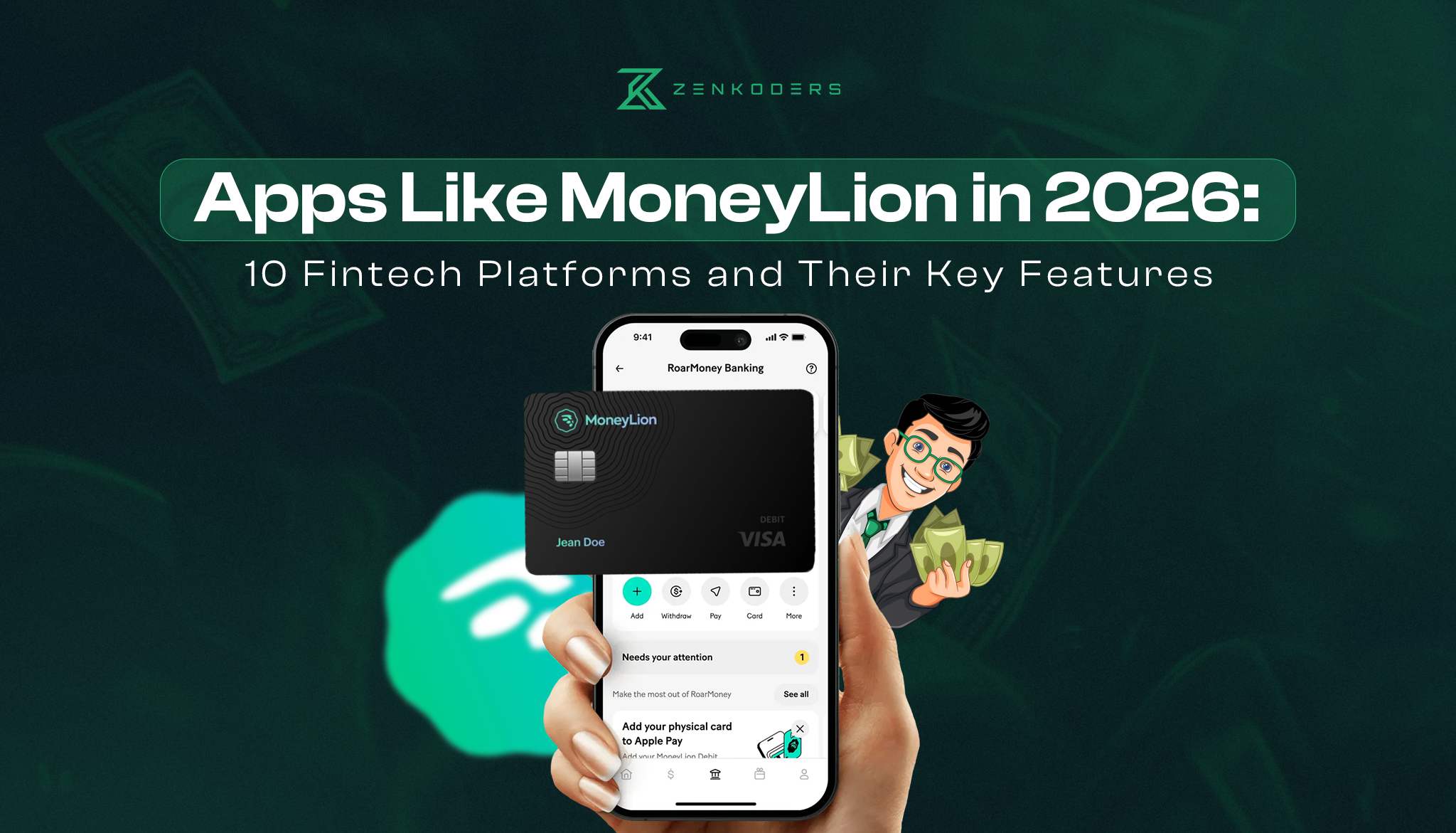

MoneyLion has become a recognizable name in consumer fintech by bringing several financial tools together in one digital experience. Rather than concentrating on a single feature, the platform combines account management, financial insights, credit-related services, rewards, and other tools intended to help users manage their financial lives.
That broader approach is one reason people frequently search for apps like MoneyLion. Some users want a simpler digital banking experience. Others are more interested in budgeting, saving, credit monitoring, subscription management, investing, or long-term financial planning.
There is also another group studying MoneyLion alternatives: founders, product leaders, and businesses planning their own fintech platforms. For them, these apps provide useful examples of customer onboarding, product design, data integrations, security, monetization, and user retention.
This guide examines ten notable platforms with features or product strategies similar to MoneyLion. It does not rank them according to promotional offers, borrowing amounts, or short-term incentives. Instead, it looks at what each platform is built to do, who it may serve, and what businesses can learn from its product model.
What Is MoneyLion?
MoneyLion is a consumer financial-technology platform designed to give users access to several financial services through one account and mobile application.
Its available ecosystem may include banking-related tools, account monitoring, credit-building services, financial insights, rewards, product recommendations, and cash-flow management features. The precise products available to a user can depend on eligibility, location, account activity, and the relevant service provider.
MoneyLion is sometimes described as a financial super-app. A super-app brings multiple connected services into one environment instead of asking users to download and manage a different application for every task.
From a product perspective, this model has a clear advantage: users can complete more activities without leaving the platform. It also creates opportunities for the company to build longer customer relationships and introduce relevant services as users’ needs change.
Creating that kind of connected experience is not simple. It requires secure account systems, reliable APIs, carefully designed user journeys, data protection, monitoring, customer support, and close attention to financial regulations. Businesses exploring a similar product can learn more about these requirements in Zenkoders’ fintech app development guide.
Why Do People Look for Apps Like MoneyLion?
People rarely search for a MoneyLion alternative because every feature of the platform is unsuitable. More often, they are looking for a product that performs one particular job in a way that better fits their needs.
One user may want a straightforward digital account with an uncluttered interface. Another may prefer stronger budgeting tools or more detailed spending insights. Someone focused on building long-term wealth may be more interested in investments, retirement planning, and net-worth tracking.
Personal preferences also matter. Financial applications differ in tone, interface design, membership structure, support options, eligibility rules, and geographic availability. A platform that feels intuitive to one person may feel unnecessarily complex to another.
For founders, examining alternatives is part of sensible competitor research. It reveals how different fintech companies solve similar problems, which features have become standard, and where users may still experience friction.
How We Selected These MoneyLion Alternatives
We selected the platforms in this guide based on their relevance to MoneyLion’s broader product ecosystem. Each one overlaps with MoneyLion in at least one significant area, such as digital account management, budgeting, credit-building, financial insights, savings, investing, or personal financial organization.
Our evaluation considered the platform’s main purpose, breadth of features, intended audience, user-experience model, and value as a fintech product example. Information should be checked against each provider’s current official website because features, eligibility, partnerships, and availability can change.
Zenkoders is a software-development company, not a financial adviser or lender. This article is educational and should not be treated as a personalized financial recommendation.
Zenkoders helps businesses design and develop custom fintech products, including mobile apps, web dashboards, backend systems, cloud infrastructure, and third-party integrations.
10 Apps Like MoneyLion to Know in 2026
1. Chime
Chime is one of the most widely recognized mobile-first financial platforms in the United States. Its product experience centers on everyday account management, payments, savings, card controls, and other digital banking features.
The application is designed to make common financial activities feel straightforward. Users can review transactions, monitor balances, manage their cards, receive account notifications, and access eligible services through a relatively focused interface.
Chime and MoneyLion overlap in their efforts to make financial services more accessible through mobile technology. However, Chime’s experience is more closely centered on digital banking, while MoneyLion presents a wider ecosystem of financial tools and product discovery.
From a product-development perspective, Chime demonstrates the value of simplicity. Financial applications can quickly become crowded with balances, alerts, offers, settings, and disclosures. Chime’s model shows why prioritizing everyday tasks can be more effective than displaying every available feature on the main dashboard.
Best suited to: Users seeking a mobile-first account experience with straightforward controls.
Product lesson: A fintech platform does not need a complicated interface to support complex financial infrastructure.
2. Dave
Dave is a financial platform focused on helping users manage everyday cash flow, understand upcoming expenses, and access digital account tools.
Its brand and interface are built around common financial pressures rather than traditional banking language. This gives the product a more approachable identity and makes its core purpose relatively easy to understand.
Compared with MoneyLion, Dave offers a more concentrated product narrative. MoneyLion covers a wider financial ecosystem, while Dave has historically positioned itself around short-term cash-flow awareness, budgeting assistance, and related account services.
For fintech founders, Dave illustrates the importance of building around a recognizable problem. Users are more likely to understand a product when its first message addresses a specific concern. Additional services can then be introduced after that initial value has been established.
Best suited to: Users interested in cash-flow awareness and mobile financial-management tools.
Product lesson: Strong positioning can make a fintech application easier to understand and remember.
3. Brigit
Brigit focuses on financial health, account monitoring, budgeting, credit-building, and proactive alerts.
One of its distinguishing qualities is its emphasis on helping users anticipate financial pressure. Instead of functioning only as an account dashboard, the platform analyzes activity and can alert users to potential problems.
This proactive approach makes Brigit similar to MoneyLion in its use of data-driven financial insights. The difference is one of emphasis. Brigit presents itself more narrowly around financial wellness and account awareness, while MoneyLion operates as a broader financial-services ecosystem.
The platform also offers a useful product lesson: notifications should solve a real problem. A message that arrives too late, lacks context, or appears too frequently will quickly lose its value. Effective financial alerts need accurate data, sensible timing, understandable language, and a clear action the user can take.
Best suited to: Users who value budgeting assistance, account monitoring, and financial-health features.
Product lesson: Proactive, relevant alerts can turn a financial app into part of a user’s routine.
4. Albert
Albert combines spending insights, budgeting, automated savings, account management, and access to financial guidance.
Its product model is notable because it blends automation with human support in some parts of its service. Many fintech companies depend almost entirely on automated recommendations, help-center articles, and chat interfaces. Albert’s approach recognizes that some financial questions benefit from human context.
Albert and MoneyLion both aim to provide more than a single financial utility. Their platforms encourage users to manage several financial activities within one environment. Albert, however, places greater emphasis on guidance, savings behavior, and personal financial organization.
For product teams, Albert demonstrates that automation should not be treated as a complete replacement for support. Algorithms can identify patterns and trigger useful suggestions, but customers may still need explanations—particularly when money, identity, or account access is involved.
Best suited to: Users looking for budgeting, savings automation, and broader financial guidance.
Product lesson: Human support can strengthen an automated financial product when it is used at the right moments.
5. Cleo
Cleo stands apart from many financial applications because of its conversational interface and distinct brand personality.
Instead of presenting only charts, tables, and conventional account screens, Cleo allows users to interact with financial information through an AI-style assistant. It can help users examine spending behavior, create budgets, set goals, and receive personalized observations.
Cleo overlaps with MoneyLion in its use of account data to provide financial insights. The main difference lies in how that information is delivered. MoneyLion largely follows a financial dashboard model, while Cleo uses conversation and personality as central elements of the user experience.
This approach offers an important lesson for fintech companies: tone can differentiate a product. Financial software does not always need to sound institutional. However, a friendly tone must never undermine accuracy, hide important conditions, or make serious financial decisions feel trivial.
Best suited to: Users who prefer conversational budgeting and a less formal app experience.
Product lesson: Brand personality can improve engagement, but clarity and responsibility must come first.
6. Current
Current is a mobile financial platform built around digital account management, payments, savings, card controls, and tools for different customer groups.
Its mobile-first design appeals particularly to users who prefer managing their financial activity without relying heavily on physical branches or traditional banking interfaces. Current has also developed products for families and younger users, allowing it to serve more than one audience through connected experiences.
Current and MoneyLion both reflect the move toward integrated consumer-finance platforms. Current is more closely associated with everyday digital banking, while MoneyLion covers a wider mix of financial management and product services.
For product teams, Current provides a useful example of audience segmentation. A platform may serve individuals, parents, teenagers, or families, but each audience requires different permissions, communication, controls, and onboarding.
Best suited to: Mobile-first users and families interested in digital account-management features.
Product lesson: Different customer groups should not be forced through an identical product journey.
7. Varo
Varo provides mobile banking, savings, payments, account alerts, credit-related tools, and other financial services.
A key distinction is that Varo operates as a nationally chartered bank in the United States. That separates it from fintech applications that provide banking services exclusively through external partner institutions.
From a user’s perspective, Varo and MoneyLion may appear similar in several areas because both offer broad mobile financial experiences. Their legal structures and operating models, however, are different. Those differences can influence how products are developed, delivered, regulated, and explained.
Varo is particularly instructive for founders who assume that every fintech app follows the same regulatory model. Some companies are software platforms, others are licensed lenders, some work with partner banks, and a smaller number operate as banks themselves.
Before building a product, a company must understand what role it will play and which responsibilities belong to its regulated partners. Zenkoders’ guide to mobile banking app development explores the technical considerations behind this type of product.
Best suited to: Users looking for a bank-led, mobile-first financial experience.
Product lesson: A fintech company’s regulatory and partnership structure shapes its entire product strategy.
8. SoFi
SoFi offers one of the broadest financial ecosystems in this group. Its services span banking, borrowing, investing, credit monitoring, rewards, and financial planning.
That breadth makes SoFi one of the closest comparisons to MoneyLion from a super-app perspective. Both companies aim to maintain long-term customer relationships by supporting different financial needs inside one ecosystem.
Their positioning is not identical. SoFi generally places stronger emphasis on investing, lending, and long-term financial progression. MoneyLion has historically focused more strongly on everyday financial access, credit-building, and connected consumer tools.
SoFi shows how a platform can use one account and membership experience to introduce several related products. This can improve convenience, but it also creates a design challenge: the application must help users find relevant services without turning every screen into a sales opportunity.
Best suited to: Users interested in combining everyday financial services with investing and longer-term planning.
Product lesson: Cross-selling works best when recommendations are relevant, transparent, and easy to dismiss.
9. Rocket Money
Rocket Money is primarily focused on budgeting, subscription tracking, expense visibility, bill management, and financial organization.
Rather than trying to reproduce every banking function, the platform addresses a highly recognizable problem: many people do not have a clear picture of where their money is going each month.
Its subscription-management functionality gives users an immediate reason to connect their accounts. Once connected, the application can provide a broader view of spending patterns and recurring expenses.
Rocket Money differs from MoneyLion because it concentrates more heavily on organizing expenses than on creating a broad financial-product marketplace. That narrower focus is also one of its strengths.
For product teams, Rocket Money demonstrates the value of a compelling first-use experience. Users are more likely to complete account connections and onboarding when they understand the benefit they will receive immediately.
Best suited to: Users focused on subscriptions, recurring expenses, budgeting, and spending visibility.
Product lesson: A strong, visible use case can reduce friction during onboarding.
10. Empower Personal Dashboard
Empower Personal Dashboard is designed around net-worth tracking, investment visibility, retirement planning, account aggregation, and long-term financial analysis.
It serves a different primary need than many everyday cash-flow applications. Instead of concentrating mainly on upcoming expenses, Empower helps users understand their wider financial position over time.
The platform overlaps with MoneyLion through account aggregation and personalized financial data. However, Empower is more closely aligned with investment monitoring, assets, and long-term planning.
Its dashboards also illustrate how thoughtful data visualization can make complicated financial information easier to understand. Good visualization is not about adding more charts. It is about helping users identify meaningful relationships without making them interpret raw data on their own.
Best suited to: Users interested in investment tracking, net worth, and long-term planning.
Product lesson: Financial dashboards should guide attention, not simply display every available data point.
MoneyLion Alternatives at a Glance
Platform | Main focus | How it differs from MoneyLion |
Chime | Mobile banking | More focused on everyday digital account management |
Dave | Cash-flow tools | Narrower positioning around common financial pressure |
Brigit | Financial health | Greater emphasis on monitoring and proactive alerts |
Albert | Budgeting and guidance | Combines automation with access to human guidance |
Cleo | Conversational budgeting | Uses personality and an AI-style interface |
Current | Mobile account management | Strong focus on mobile-first banking and family products |
Varo | Digital banking | Operates through a bank-led model |
SoFi | Broad financial ecosystem | Greater emphasis on investing, lending, and long-term services |
Rocket Money | Expense organization | Concentrates on subscriptions, bills, and budgeting |
Empower | Wealth tracking | More focused on investments and long-term planning |
This table is intended as a high-level product overview. It is not a financial ranking, and product availability may vary.
Studying apps like MoneyLion is a useful starting point, but the right product should be built around your users, market, and business model.
Explore Zenkoders’ fintech app development services or contact the team to discuss your product requirements.
Features Commonly Found in Apps Like MoneyLion
Although the platforms above follow different strategies, several capabilities appear repeatedly across modern financial applications.
Account Connectivity
Many fintech products allow users to connect external accounts and bring financial information into one interface. This can help users understand their balances, spending, recurring expenses, debts, savings, and investments.
Behind a simple “connect account” button is a complex system of authentication, consent, data providers, synchronization, categorization, and error handling. These systems often rely on APIs to exchange information between approved services.
Account connectivity must also be transparent. Users should know what data an application can access, how long permission remains active, and how to disconnect an account.
Personalized Insights
Financial platforms increasingly use transaction data to identify patterns and present personalized observations.
An app might recognize a recurring bill, detect a change in spending, highlight a savings opportunity, or notify the user about unusual activity. These features can be valuable, but only when the underlying data is accurate and the recommendation is explained clearly.
Responsible products should also give users a way to correct miscategorized transactions or dismiss irrelevant suggestions.
Clear Financial Dashboards
A financial dashboard should answer the user’s most important questions quickly. What is my current position? What recently changed? Is there something that requires my attention?
Poor dashboards overwhelm users with unrelated figures and promotional cards. Strong dashboards use hierarchy, plain language, and progressive disclosure to show the right information at the right time.
This is where professional UI/UX design and development becomes essential. In fintech, design affects more than appearance; it influences understanding, confidence, accessibility, and decision-making.
Notifications and Automation
Notifications can help users keep track of deposits, payments, balances, subscriptions, security events, and account changes. Automation can support savings, transfers, categorization, and routine account tasks.
Both capabilities require careful control. Users should be able to decide which notifications they receive and understand when automated actions will occur. Unexpected financial actions can damage trust even when the product technically behaves as designed.
Identity, Security, and Privacy Controls
Financial apps regularly handle sensitive personal and account information. Security cannot be added as a final feature shortly before launch.
A responsible product may require encryption, secure authentication, multi-factor verification, device monitoring, role-based permissions, audit logs, fraud controls, incident response, and secure data storage.
Privacy deserves equal attention. Users should receive understandable information about what data is collected, why it is needed, and with whom it may be shared.
How to Choose an App Similar to MoneyLion
The most appropriate platform depends on what you are actually trying to accomplish.
Begin with your primary goal. Someone who wants a simple mobile account may evaluate different products than someone focused on subscriptions or investment tracking. A long feature list is not automatically more useful.
Next, examine the company and its role. Determine whether the service is provided by a bank, a fintech platform, a lender, an adviser, or a combination of regulated partners. Review the disclosures for the particular product you intend to use rather than assuming every feature follows the same terms.
Security and customer support should also influence the decision. Look for understandable privacy information, reliable account-recovery processes, fraud-reporting options, and clear ways to contact support.
Finally, confirm current availability. A feature advertised on a general product page may depend on location, eligibility, account type, or a phased rollout.
What Founders Can Learn From These Fintech Platforms
Studying successful fintech products is useful, but copying their feature lists is not a sound product strategy.
Start With One Meaningful Problem
MoneyLion and SoFi now offer broad ecosystems, but a new product does not need to launch with the same scale.
A focused minimum viable product gives the team room to test demand, correct assumptions, and improve the core experience before introducing additional services. Zenkoders’ guide to the importance of an MVP in mobile app development explains why this staged approach can reduce risk.
Build Trust Through Clarity
Financial users need to understand what is happening to their accounts and data. Important conditions should not be buried behind vague labels or confusing interface patterns.
Clear confirmations, understandable errors, visible account status, accessible language, and responsive customer support all contribute to trust.
Design the Entire Product Ecosystem
A consumer mobile app is only one part of a fintech platform. The complete system may also include administrative dashboards, support tools, backend services, analytics, notifications, data integrations, security monitoring, and reporting.
Depending on the product, businesses may need both mobile app development and custom web application development to support customers and internal teams.
Choose Technology Based on Requirements
Native development may offer stronger access to platform-specific capabilities, while cross-platform frameworks can help teams share code between iOS and Android.
There is no universally correct choice. Performance, security, integrations, team expertise, timeline, maintenance, and product complexity all matter. Businesses considering a shared codebase can review Zenkoders’React Native app development services.
Involve Compliance Specialists Early
Software engineers should not guess which financial rules apply to a product.
The legal and compliance model can affect onboarding, disclosures, identity verification, data retention, transaction monitoring, customer support, marketing, and even basic interface design.
Qualified legal, financial, regulatory, and cybersecurity professionals should be involved before major architecture and product decisions become expensive to change.
How Zenkoders Approaches Fintech App Development
Zenkoders approaches financial software as a connected system rather than a collection of screens.
A fintech project may involve product discovery, UX design, mobile development, backend engineering, web dashboards, identity-verification services, financial-data APIs, payment integrations, cloud infrastructure, quality assurance, security testing, and ongoing monitoring.
The process should begin by defining the customer problem, target users, geographic market, operating model, and minimum viable product. Once those foundations are clear, the product team can create user journeys, technical requirements, integration plans, security controls, and a realistic delivery roadmap.
Architecture decisions should also account for growth. A prototype that works for a small test group may not support large transaction volumes, complex permissions, or multiple financial partners.
Zenkoders provides custom software development services for businesses building mobile applications, web platforms, backend systems, cloud solutions, and connected digital products.
Zenkoders does not provide banking, lending, financial, investment, legal, or regulatory advice. Fintech businesses should work with appropriately qualified specialists for those areas.
Final Thoughts
MoneyLion is part of a broader shift toward connected, mobile-first financial services.
Chime, Dave, Brigit, Albert, Cleo, Current, Varo, SoFi, Rocket Money, and Empower all address overlapping financial needs, but each platform has its own audience, product structure, and user-experience strategy.
For consumers, the best choice depends on the task they are trying to complete and the service currently available to them.
For founders, the larger lesson is more valuable than any individual feature comparison. Successful fintech products are built on trust. They need a clear purpose, understandable design, reliable data, secure architecture, transparent communication, and professional compliance oversight.
A polished interface can attract attention, but only a dependable product earns the right to manage someone’s financial information.
FAQs:
What apps are similar to MoneyLion?
Apps with functionality or product strategies similar to MoneyLion include Chime, Dave, Brigit, Albert, Cleo, Current, Varo, SoFi, Rocket Money, and Empower. Each overlaps with MoneyLion in different areas, including digital banking, budgeting, account monitoring, savings, credit-related tools, or financial insights.
Which app is most similar to MoneyLion?
SoFi is one of the closest comparisons from a financial super-app perspective because it offers a broad ecosystem of services. Chime and Varo are more comparable in digital banking, while Albert, Brigit, and Cleo have stronger similarities in budgeting and financial-health tools.
Is MoneyLion a bank?
MoneyLion is a financial-technology company rather than a traditional bank. Banking and other regulated financial services may be provided through relevant partner institutions. Users should check the official disclosures associated with each product.
Are apps like MoneyLion safe?
Established fintech companies commonly use encryption, identity verification, fraud controls, and secure authentication. No platform is completely risk-free, however. Users should examine the provider’s privacy policy, security controls, regulated partners, support channels, and account-recovery process.
What should I look for in a MoneyLion alternative?
Consider your main financial goal, the company behind the product, current availability, security controls, privacy practices, customer support, and how clearly the platform explains its services. Do not select an app based only on a temporary promotion.
What features are needed to build an app like MoneyLion?
A broad fintech platform may require authentication, identity verification, account connections, dashboards, transaction processing, data categorization, notifications, consent controls, customer support, audit logs, analytics, administrative systems, and secure third-party integrations.
The actual feature set should be based on a clearly defined customer problem rather than copying an existing platform.
How long does it take to develop a fintech app?
A focused fintech MVP may require several months, while a multi-product platform can take considerably longer. The schedule depends on features, integrations, regulatory requirements, security reviews, design complexity, partner approvals, testing, and supported platforms.
Can Zenkoders develop an app similar to MoneyLion?
Zenkoders can design and develop mobile apps, web dashboards, backend systems, APIs, cloud infrastructure, and third-party integrations for fintech products.
The product scope and regulatory model should be developed with qualified financial, legal, compliance, and cybersecurity professionals.